Physical Address
304 North Cardinal St.
Dorchester Center, MA 02124
Physical Address
304 North Cardinal St.
Dorchester Center, MA 02124

If you’ve come across blueflamepublishingblog.com, you may be wondering what the website offers and whether its articles are worth your time. The name sounds like a publishing platform, but understanding a website requires more than looking at its domain. You need to consider its content, purpose, and the information it shares with readers.
This guide examines BlueFlamePublishingBlog.com from several angles, including its topic categories, publishing identity, ownership information, and content reliability. It also explains how to evaluate the website before relying on an article or considering a guest-post opportunity. These details can help you understand what the domain may offer and where further verification matters.
One important distinction runs throughout this article: a website’s existence doesn’t automatically prove every claim it publishes. Likewise, a familiar name doesn’t establish a connection with similarly named domains. By checking the available evidence carefully, you can make better decisions about reading, researching, or working with an online publication.
BlueFlamePublishingBlog.com presents itself as an online publication covering several general-interest subjects. Rather than focusing exclusively on books or professional publishing, its content spans areas such as business, technology, health, and travel. This broader approach gives readers access to different topics through one website.
However, a domain name alone doesn’t tell you everything about a publication. If you’re trying to understand its purpose, examine the homepage, About page, article categories, and author information. These details provide a clearer picture of the website’s intended audience and the material it publishes.

The website’s public description presents it as a place for informational articles, practical ideas, and content covering different interests. Its publishing-related branding also suggests an interest in writing and digital content. Together, these elements point toward a general online publication rather than a narrowly focused book catalog.
When evaluating that description, compare it with the articles available on the site. For example, a website that describes itself as a broad information resource should have content that reflects that purpose. Checking the actual pages helps you understand whether the stated mission matches the published material.
The name BlueFlamePublishingBlog.com may initially sound like a resource for authors, editors, or people interested in traditional publishing. You might expect information about manuscripts, book production, or publishing services. However, the website’s reported content covers a wider range of subjects.
This difference isn’t necessarily unusual. Many online publications use broad brand names while publishing articles across several categories. The sensible approach is to judge BlueFlamePublishingBlog.com by its visible content and clearly stated purpose, rather than making assumptions based on its name.
A multi-topic website can attract readers with different interests without limiting itself to one subject. According to the competitor article, BlueFlamePublishingBlog.com features content across business, technology, health, and travel. These categories suggest an approach built around general information rather than a single specialized audience.
That variety can be convenient, but it also makes content evaluation important. An article about a vacation destination requires different evidence from one discussing a medical condition or financial decision. Understanding these differences helps you decide how much weight to give each article.
Business and technology articles often cover online platforms, digital tools, entrepreneurship, and content marketing. Readers may turn to these topics when researching a company, understanding a service, or learning about developments in the digital world.
For example, an article discussing an online business platform might help you understand its purpose before visiting the company’s official website. Still, verify important claims through company documentation, current product information, or other reliable sources. This is particularly useful when comparing services or making business decisions.
Health and wellness content can include nutrition, vitamins, mindfulness, mental well-being, and everyday lifestyle habits. These subjects appeal to readers looking for general explanations or practical ideas they can discuss with qualified professionals.
However, health information deserves careful attention. A blog post shouldn’t replace medical advice, and a confident statement doesn’t automatically make a claim accurate. If an article discusses symptoms, treatments, supplements, or medical conditions, compare its claims with reputable medical institutions and public-health authorities.
Travel content can help readers learn about destinations, attractions, cultural experiences, and possible vacation activities. Articles about romantic getaways, wildlife safaris, temples, or wellness retreats can also provide ideas for future trips.
Suppose you find a destination that interests you. Use the article to build an initial list of places to visit, then confirm practical details through official tourism websites and local providers. Opening hours, travel restrictions, transportation options, and prices can change, so current information matters.
The combination of business, technology, health, and travel suggests that BlueFlamePublishingBlog.com serves a broad informational purpose. You may find useful introductory material without needing to visit several specialized websites immediately.
Still, variety doesn’t guarantee depth or accuracy. Before relying on an article, consider its subject, evidence, publication date, and author credentials. This simple habit helps you separate general reading material from information that requires stronger verification.
The distinction between a publishing company and a content website matters because these terms describe different activities. A traditional publishing business may produce books, manage manuscripts, negotiate publishing agreements, or work directly with authors. An online content website generally focuses on publishing digital articles for readers.
The available description of BlueFlamePublishingBlog.com emphasizes its online articles and broad subject categories. That supports describing it as a multi-topic content publication. It doesn’t, by itself, establish whether the operator also offers traditional publishing services or runs a separate publishing business.
A publishing company typically provides identifiable publishing services or produces formal publications, such as books and magazines. Depending on its business model, it may handle editing, production, distribution, rights, and contracts.
A blog or online publication can operate differently. It may publish informational articles, commentary, guides, and other digital content without offering book publishing services. Some businesses do both, so you should check the specific services a website actually provides before deciding which category fits.
Article categories, navigation menus, author bylines, and individual posts offer useful clues about a website’s primary function. A homepage organized around business, technology, health, and travel articles looks more like a general content publication than a traditional book catalog.
The competitor article also mentions multiple author bylines and a mixture of article topics. Those details help explain the site’s apparent publishing model, although they don’t independently confirm its legal structure or commercial activities. For a clearer answer, look for specific service pages and verifiable business information.
Don’t assume that BlueFlamePublishingBlog.com accepts manuscripts, represents writers, or offers book publishing contracts simply because its name includes the word publishing. Those services require direct evidence.
Before contacting the website for professional publishing assistance, look for submission guidelines, service descriptions, contract information, and identifiable business details. If these are missing or unclear, ask the operator to explain exactly what it offers. A clear answer is more useful than relying on the brand name alone.
Websites sometimes use similar names while operating independently. The competitor article references other domains containing the BlueFlamePublishing name, including blueflamepublishing.org, blueflamepublishing.blog, and blueflamepublishing.net. However, similar branding doesn’t prove common ownership or shared management.
This distinction matters when researching a website’s reputation, services, or background. Information published on one domain shouldn’t automatically be attributed to another. Verify the identity of each website before treating them as parts of the same organization.
A small difference in a domain name can take you to an entirely different website. Search results may also include directories, third-party reviews, guest-post listings, or articles discussing related businesses.
For example, a page describing a publishing service on one domain doesn’t establish that another similarly named website provides the same service. Even matching logos or brand colors aren’t conclusive proof. Look for direct statements about ownership and supporting evidence before connecting separate domains.
Start by checking the complete domain in your browser’s address bar. Make sure you’re reviewing blueflamepublishingblog.com rather than a similar address that appeared in search results.
Next, examine the website’s About and Contact pages, author profiles, and any business information it provides. If the site claims an association with another organization, look for confirmation from both sides. Domain registration records may provide additional clues, although privacy protection can limit the information available.
Keep the information you gather about each domain separate until you find reliable evidence connecting them. Record the exact website address, the claims it makes about ownership, and the source supporting those claims.
This approach is useful for readers, researchers, and marketers alike. It prevents you from confusing one site’s reputation with another’s and helps you avoid relying on outdated or incorrectly attributed information.
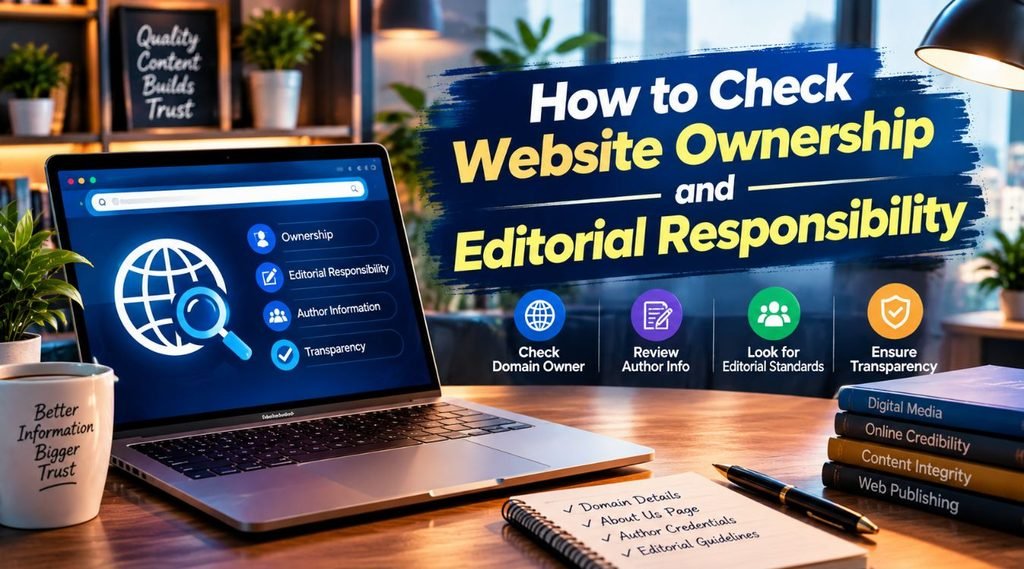
Website ownership is a reasonable concern when you’re deciding whether to trust an article or contact a publication. Readers may want to know who writes the content, who manages the website, and whether the people responsible are identifiable.
The competitor article describes basic website information, including About and Contact pages, but doesn’t establish every detail about the operator’s legal identity. Therefore, it’s better to distinguish between the information the website displays and ownership details that require independent confirmation.
An About page can explain a publication’s goals, subject areas, and intended audience. Author bylines may also identify the people credited with individual articles. Together, these details provide a starting point for understanding the website’s editorial identity.
However, a listed author isn’t necessarily the owner or publisher. Likewise, a general contact email doesn’t establish the name of a registered business. If ownership matters to your decision, look for consistent details across the website and other reliable records.
You can assess a website’s transparency by checking several publicly available details:
Domain registration information may offer additional clues, but it doesn’t always reveal the actual operator. Consider multiple sources rather than relying on a single record.
An unfamiliar author name, generic byline, or limited company information isn’t enough to identify a website’s owner. Guessing can lead to incorrect claims, especially when multiple domains use similar branding.
If the operator isn’t clearly identified, describe that limitation accurately. You can still evaluate individual articles by examining their evidence, sources, and accuracy. In other words, uncertain ownership and unreliable content aren’t automatically the same thing, although transparency remains worth considering.
Website credibility depends on more than a professional layout or a recognizable domain name. You should consider whether an article supports its claims, identifies its author, provides useful sources, and presents information fairly.
The competitor article advises readers to verify high-stakes information through authoritative sources. That’s a sensible approach for any multi-topic publication. Rather than making a blanket judgment about every page, evaluate the specific information you intend to use.
Start by identifying the article’s main claim. Then check whether the writer provides evidence, references credible sources, and explains relevant limitations.
Look for the following signs of stronger content:
No single factor guarantees accuracy. However, several positive signs together can give you a stronger basis for deciding whether an article deserves your confidence.
Some information has greater consequences if it’s wrong. Health advice can influence treatment decisions, financial claims can affect your money, and legal information can shape important choices.
For these subjects, prioritize original research, official guidance, qualified professionals, and relevant government resources. A general blog post may help explain unfamiliar terminology, but it shouldn’t be your only source for a consequential decision. Always check whether the information applies to your particular situation.
Imagine BlueFlamePublishingBlog.com publishes an article about vitamin D deficiency. Before acting on its recommendations, compare the main medical claims with guidance from a recognized medical institution or public-health agency.
Check whether the article accurately describes symptoms, testing, and treatment. Pay attention to publication dates and whether the cited evidence supports the recommendations. If the sources disagree or important details are missing, ask a qualified healthcare professional rather than making assumptions.
A practical evaluation doesn’t need to take hours. Start with the article’s author, date, main claims, and supporting evidence. Then compare its most important statements with an independent, trustworthy source.
Be cautious when a page makes sweeping promises, hides the basis for its claims, or uses outdated information without explanation. You don’t need to reject an article for every minor weakness. Instead, match your level of confidence to the quality of the evidence and the importance of the decision.
A general-interest publication may be useful when you want an introduction to an unfamiliar subject. It can help you identify relevant terms, understand basic concepts, or find ideas worth researching further.
BlueFlamePublishingBlog.com covers several categories according to the competitor article, so its usefulness depends on your interests and the specific page you’re reading. Treat the site as one possible information source rather than assuming it meets every research need.
Introductory articles can help you understand a topic before moving to more specialized material. For instance, a business article might introduce an online service, while a travel guide might suggest destinations for a future trip.
Once you’ve identified what interests you, check the original sources. Visit the company’s official website for service details or a tourism authority for current travel guidance. This two-step process combines convenient reading with more dependable verification.
Multi-topic websites can introduce you to subjects you might not otherwise search for. A technology article could raise questions about a digital tool, while a wellness post might introduce a general self-care practice.
Use these articles to develop your understanding and generate follow-up questions. If you’re researching a complex subject, compare several credible sources before drawing conclusions. The goal isn’t to find one page that answers everything, but to build an accurate picture from relevant evidence.
Some questions require information directly from the organization responsible for a service, rule, or recommendation. Examples include current government requirements, medical guidance, product specifications, and financial regulations.
In these cases, go beyond a general blog article. Check official documentation, primary research, or qualified professional advice as appropriate. This is especially important when details change frequently or a mistake could have significant consequences.
Some people search for a domain because they’re considering guest posting, sponsored content, or link insertion. Their main concern isn’t necessarily the website’s subject matter. They want to know whether publishing there makes sense for their marketing goals.
If that’s your situation, evaluate the placement separately from the website’s informational value. A third-party listing may advertise a service, but the listing alone doesn’t establish traffic quality, editorial standards, or SEO benefits.

A marketplace listing may describe the offered placement, price, link type, publishing requirements, and expected turnaround time. These details can help you understand what a seller claims to provide.
However, seller-provided information should be verified before you spend money. Ask which page will contain your content, whether the link will be followed or marked as sponsored, and what happens if the article is removed. Clear terms reduce uncertainty before you commit.
Evaluate the website’s relevance to your audience and the quality of its published articles. Review its organic visibility, referring domains, outbound links, and the general quality of pages receiving search traffic.
You should also ask for written placement terms and confirm the exact page or content format being offered. Be cautious about guaranteed ranking improvements or promises that a paid link will deliver a specific amount of traffic. Search performance depends on many factors, and no placement can guarantee a particular result.
A website can publish helpful articles without being the right place for your backlink campaign. Likewise, the availability of paid placements doesn’t automatically establish that its content is unreliable.
Consider your goals separately. For readers, focus on evidence and content accuracy. For marketers, consider audience relevance, editorial quality, link practices, and potential search risks. This distinction helps you make a decision based on your actual objective rather than a single website metric.
If you’re researching BlueFlamePublishingBlog.com for SEO, look beyond the domain name and any advertised authority score. A backlink’s potential value depends on several factors, including topical relevance, editorial context, page quality, and how the link is presented.
No single metric proves that a placement will improve rankings. Use multiple sources of evidence, and remember that third-party SEO tools estimate performance rather than revealing every detail of a search engine’s ranking systems.
Start by reviewing the site’s estimated organic traffic and referring domains through reputable SEO tools. Compare trends over time instead of judging the domain from one snapshot.
Then consider whether its content relates naturally to your website. A relevant article that genuinely serves readers may make more sense than an unrelated placement chosen solely for a backlink. Also inspect the quality of the pages that link to the site and whether its content appears useful to real visitors.
Look at how the website links to other sites. Are links relevant to the surrounding article, or do pages contain large numbers of unrelated commercial links? Do sponsored placements appear to be disclosed appropriately?
Paid links intended to manipulate search rankings can create SEO risks. Google’s policies distinguish qualifying sponsored links from ordinary editorial links. Before purchasing a placement, review current search engine guidance and ensure the arrangement follows applicable link-spam rules. Focus on legitimate audience value instead of promises of quick ranking gains.
The word legitimate can mean several different things. You might want to know whether the website is accessible, whether its operator is identifiable, whether an advertised service exists, or whether its articles contain reliable information.
These questions require different evidence. A working website doesn’t automatically prove the accuracy of its content, and an incomplete About page doesn’t independently prove wrongdoing. Define what you want to verify, then examine the information relevant to that question.
Look for a working contact method, a clear description of the publication, identifiable author information, and any available editorial policies. Check whether the website explains how it handles corrections, sponsored content, or conflicts of interest.
If you’re considering a commercial arrangement, request written details about the service and payment terms. Where a company name or registration number is provided, check the appropriate official records. Consistent information across independent sources provides a stronger basis for confidence than a polished website alone.
Be cautious if an offer includes pressure to pay immediately, unclear terms, unverifiable claims, or requests for unnecessary personal or financial information. Broken contact channels and inconsistent business details also deserve attention.
One warning sign alone may have an innocent explanation, so avoid jumping to conclusions. Instead, look for a pattern and ask questions before proceeding. Use secure payment methods, share only necessary information, and keep written records of agreements and receipts.
Good online research involves more than finding an article that matches your search query. You also need to determine whether its information is current, whether its sources support the main claims, and whether the author understands the subject.
These checks are useful for any online publication, including BlueFlamePublishingBlog.com. They help you avoid repeating outdated information or relying on claims that haven’t been adequately supported.
Start by checking when the article was published and whether it has been updated. Older material may still be accurate, but information about travel conditions, technology, regulations, and medical guidance can change.
Next, review the author’s relevant qualifications and the evidence cited in the article. Follow important citations back to their original sources when possible. A recent publication date isn’t a guarantee of accuracy, but current information supported by credible evidence is generally more useful for decisions that depend on changing facts.
An article may combine established facts, personal interpretations, examples, and recommendations. Understanding the difference helps you assess what the writer has actually demonstrated.
For instance, a statement about a website’s visible categories can be checked by visiting its pages. A claim about its private ownership may require independent records or confirmation from the operator. Treat each statement according to the evidence needed to support it, and avoid repeating uncertain claims as established facts.
BlueFlamePublishingBlog.com is described in the competitor article as a multi-topic online publication covering business, technology, health, travel, and related subjects. Its name may suggest a narrower focus on publishing, but the reported article categories indicate a broader content model.
The key is to distinguish the website’s apparent purpose from questions that require further verification. Its name doesn’t establish that it operates as a traditional book publisher, and similar BlueFlamePublishing domains shouldn’t be assumed to share an owner without supporting evidence.
If you’re reading the site, assess each article’s sources, author information, and relevance to your question. If you’re considering a guest post or backlink, examine audience fit, link practices, editorial quality, and the terms of the offer. A careful review gives you a stronger basis for deciding whether the website meets your needs.
BlueFlamePublishingBlog.com is described as a multi-topic online publication featuring business, technology, health, travel, and other general-interest articles.
Its reported website content focuses on online articles. Traditional book publishing services should be confirmed through explicit service descriptions and verifiable business information.
Evaluate individual articles by checking author credentials, publication dates, supporting evidence, and independent sources before relying on important information.
The available description doesn’t conclusively establish its legal owner. Check the website’s contact information, ownership disclosures, and relevant public records for confirmation.
Third-party listings may advertise guest-post placements. Confirm current availability, editorial requirements, link terms, and payment conditions directly before making any commitment.
Similar names don’t prove common ownership. Compare official disclosures and seek confirmation from both websites before treating them as related organizations.
Review topical relevance, organic traffic estimates, referring domains, outbound links, editorial quality, and sponsored-link practices before considering a placement.
Understanding BlueFlamePublishingBlog.com starts with looking beyond its name. The site is described as a broad online publication rather than a resource devoted exclusively to traditional publishing. Its reported categories include business, technology, health, and travel, making it relevant to readers with varied interests.
However, a broad content range doesn’t automatically establish authority. Check the evidence behind individual articles, verify important claims through reliable sources, and confirm ownership details when they matter. If you’re considering a guest-post offer, assess its SEO implications and commercial terms separately from the website’s informational value.
Ultimately, blueflamepublishingblog.com should be evaluated according to what you need from it. Use general articles to build understanding, authoritative sources to verify consequential claims, and independent SEO evidence to assess marketing opportunities. That approach keeps your research practical, informed, and grounded in facts.