Physical Address
304 North Cardinal St.
Dorchester Center, MA 02124
Physical Address
304 North Cardinal St.
Dorchester Center, MA 02124


Ever come across a word that looks familiar but leaves you scratching your head? That’s where frescade meaning gets interesting. You may have seen this uncommon term while reading an old book, studying vocabulary, or exploring unusual English words. At first glance, it can seem confusing. Don’t worry. This guide will make it easier to understand.
If you enjoy learning about tricky words, you’ve probably faced similar questions. For example, you might wonder, “i would love to or too,” “sleave vs sleeve,” or “cacoon or cocoon.” English has plenty of words and spellings that can trip you up. Sometimes, even a small difference changes the meaning completely.
The Frescade meaning curiosity applies to unusual terms like frescade. What does it mean? Where did it come from? Is it still used today? You’ll find clear answers here, along with useful examples. We’ll also look at tought vs taught and minoot, so you can understand these language questions with confidence.
Frescade meaning refers to a cool walk, shady place, or shaded walkway. It’s a noun, and it describes an outdoor setting that offers coolness or shelter from the sun.
Merriam-Webster defines frescade as a cool walk or shady place, while Collins gives the closely related meanings “a shaded walkway” and “a cool walk.”
| Feature | Meaning |
| Word | Frescade |
| Part of speech | Noun |
| Main meaning | A cool walk or shady place |
| Pronunciation | fres-KAYD |
| Plural | Frescades |
| Usage today | Very rare |
| Typical context | Literary, historical, or descriptive writing |
Simple example:
They followed the frescade beneath the tall trees to escape the afternoon heat.
If you’ve never seen the word before, that’s completely understandable. Frescade is legitimate English, but it has largely disappeared from everyday speech.

At its core, the frescade definition describes a pleasant, cool outdoor setting. Think of a shaded garden path, a leafy walkway, or another place where someone can escape intense heat.
The word can focus on the walk itself or the shady place associated with that walk. Historical dictionary evidence supports both ideas. The World English Historical Dictionary records frescade as a “cool walk” or “shady alley,” with examples going back centuries.
The clearest frescade meaning in English is a cool walk or shady place.
Collins lists two closely related senses: a shaded walkway and a cool walk. Merriam-Webster likewise treats the word as a noun connected with a cool walk or shady place.
So, if you’re wondering what does frescade mean, picture this:
A tree-covered path where someone walks to enjoy shade and cooler air.
That image captures the word better than a complicated definition.
In simple English, frescade means a cool or shaded place, especially a walkway.
You could think of it as an old-fashioned alternative to phrases such as:
For example:
After walking through the hot courtyard, they entered the frescade beneath the trees.
The surrounding sentence makes the meaning easy to understand.
Yes. Frescade is a real English word.
Its unusual appearance can make it look invented, but established dictionaries record it as a noun. Merriam-Webster and Collins both provide definitions for the term.
The word is simply rare. A word doesn’t have to appear in everyday conversation to be legitimate. English contains plenty of old, specialized, regional, and literary terms that most people rarely encounter.
Historical records also show frescade in English writing from the 1600s onward.
A common pronunciation is fres-KAYD, with the emphasis on the second syllable.
Merriam-Webster gives the pronunciation as fresˈkād, while Collins gives frɛsˈkeɪd.
So it sounds roughly like:
fress-KAYD
It’s close enough to the sound of “cascade” to make the pronunciation easier to remember.
The word can be divided as:
fres-cade
The main stress falls on cade.
Say it naturally as:
fres-KAYD
You don’t need to stretch the first syllable. Keep it short, then emphasize the second.
Because frescade is unfamiliar, people may pronounce it by comparing it with words they already know.
Common errors include:
The safest approach is to remember the two-syllable pronunciation: fres-KAYD.
The frescade etymology has a surprisingly long history.
Merriam-Webster traces the English word through obsolete French to Middle French and probably to Old Provençal frescada. That older form was associated with the cool of evening or a cool drink. The root fresc meant “fresh” and has a Germanic connection.
Another historical dictionary source records frescade as coming from French, adapted from Italian frescata, related to fresco, meaning cool or fresh.
The important point is that the word has a genuine historical trail. It wasn’t created recently as internet slang.
The central idea behind frescade has remained remarkably stable: coolness, shade, and a pleasant outdoor walk or place.
Historical records show the word being associated with cool places, shaded areas, gardens, and outdoor retreats. A 1656–81 dictionary entry, for example, connected frescades with cool air, cool places, drinks, and shaded areas.
Over time, however, everyday English moved toward simpler expressions.
| Earlier term | Modern alternatives |
| Frescade | Shaded walkway |
| Frescade | Shady path |
| Frescade | Cool retreat |
| Frescade | Garden walk |
| Frescade | Sheltered place |
The concept survived. The unusual word simply became much less common.
Frescade is a noun. It names a cool walk or shady place rather than describing another thing.
For example:
The word works especially well when the surrounding sentence establishes a garden, path, trees, shade, or warm weather.
Use frescade as a noun.
Correct:
The frescade stretched beneath the old trees.
Correct:
They enjoyed a peaceful frescade after lunch.
Avoid turning it into an adjective simply because its meaning involves coolness.
Unnatural:
The afternoon was frescade.
A better sentence would be:
The afternoon walk led through a cool, shaded garden.
The distinction is simple: frescade names the place or walk; it doesn’t normally describe weather or objects.
You can use frescade in formal writing, but its rarity matters.
The word is most comfortable in literary, historical, descriptive, and academic discussions of vocabulary. It can give prose an older or more distinctive feel.
For example:
The manor’s gardens included a secluded frescade beneath the cypress trees.
That sounds intentional because the setting supports the unusual vocabulary.
In a business email, however, the word would probably feel distracting. If you simply mean “shaded walkway,” say that instead.
The word sounds most natural when you’re describing a peaceful outdoor setting.
Imagine a historic estate with gardens, fountains, trees, and stone paths. A sentence such as this fits:
Beyond the fountain, a cool frescade led toward the orchard.
The context does most of the work. Even readers unfamiliar with the word can usually infer its meaning from the surrounding description.
It also works nicely in poetry and atmospheric prose because it carries a distinctly old-fashioned flavor.
You probably shouldn’t use frescade when your audience needs immediate, effortless understanding.
For example, a public sign should say:
Shaded walkway
rather than:
Frescade
Likewise, general websites, instructions, product descriptions, and everyday messages usually benefit from familiar wording.
Choose a simpler phrase when:
Rare vocabulary can be interesting. It shouldn’t become a barrier.
Seeing frescade in a sentence makes its meaning easier to recognize.
Here are several original examples:
The travelers found a cool frescade beneath the spreading oaks.
The estate’s garden included a narrow frescade beside the fountain.
She spent the warm afternoon walking through the shaded frescade.
After crossing the sunlit courtyard, they welcomed the coolness of the frescade.
Each example connects the word with shade, walking, or relief from heat.
Historical texts provide evidence that frescade was used for cool or shaded places.
A historical dictionary records an 18th-century example describing gardens and “frescades” beside water.
That kind of usage helps explain the word’s association with gardens and refreshing outdoor spaces.
In literary writing, frescade can help establish atmosphere.
The quiet frescade disappeared beneath a canopy of leaves.
Here, the word does more than identify a path. It helps create a calm, secluded mood.
The botanical garden offered a cool frescade lined with flowering shrubs.
This use makes the meaning fairly clear even for someone encountering the term for the first time.
At sunset, the travelers left the dusty road and entered a frescade of trees and cool evening air.
This example uses the word to create a transition from heat and exposure into shade and comfort.
No. Frescade is very uncommon in modern everyday English.
You’re much more likely to encounter it while reading a dictionary, exploring historical vocabulary, or coming across older literary writing.
That doesn’t make it incorrect. It simply means most modern speakers would choose a more familiar phrase.
For instance, someone today might say:
Those expressions are much more natural in ordinary conversation.
Frescade has an old-fashioned feel because modern speakers rarely use it.
It belongs to a type of vocabulary that once appeared in descriptive writing but gradually lost ground to simpler, more familiar expressions.
Historical sources document its use across several centuries, including examples from the 17th, 18th, and 19th centuries.
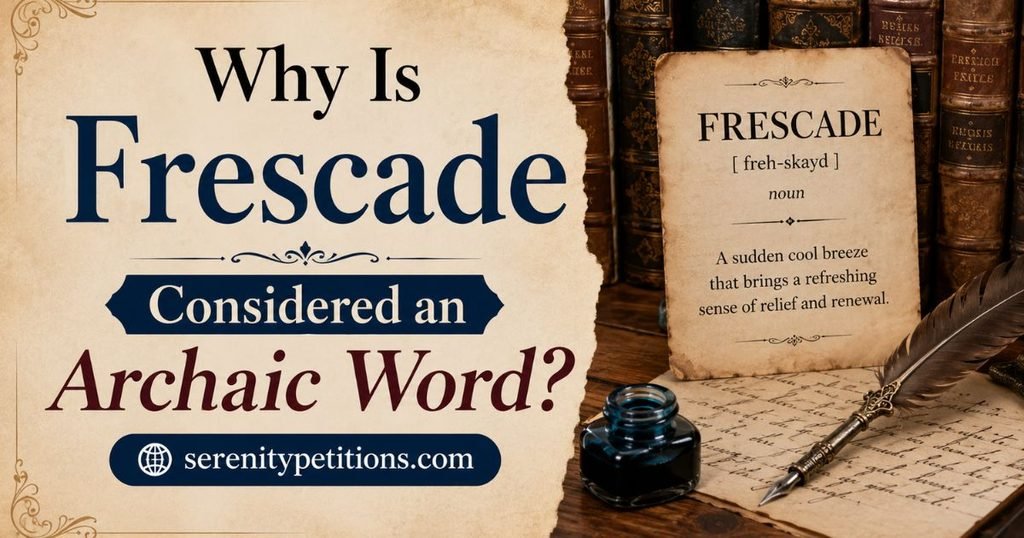
Modern English has plenty of straightforward ways to express the same idea.
Instead of frescade, people commonly use:
These phrases require no explanation.
Everyday language tends to favor expressions that listeners understand immediately.
If “shady path” communicates the idea perfectly, there’s little practical reason for most speakers to choose the much rarer frescade.
That doesn’t mean rare words disappear completely. They can survive in dictionaries, literature, historical records, and specialized discussions.
The word’s narrow meaning may also have limited its everyday usefulness.
Modern life provides countless ways to describe outdoor spaces without needing one specialized noun. “Shaded walkway” works in a garden, park, resort, campus, or public space.
As language changes, words with narrow applications can become less familiar.
If your goal is clear modern English, these alternatives are usually better:
| Alternative | Best use |
| Shaded walkway | A path protected from direct sunlight |
| Shady path | Casual everyday description |
| Garden path | A walkway through a garden |
| Cool retreat | A place offering relief from heat |
| Tree-lined walkway | A path bordered by trees |
| Outdoor stroll | A relaxed walk outside |
| Sheltered walk | A walk protected from weather or sun |
The best choice depends on the exact meaning you want.
For example, garden path focuses on location. Cool retreat focuses on comfort. Shaded walkway focuses on the physical path.
Frescade and fresco are different words with different meanings.
A frescade relates to a cool walk or shady place. A fresco refers to a painting made on wet plaster.
| Word | Meaning | Typical context |
| Frescade | Cool walk or shady place | Historical or literary writing |
| Fresco | Painting made on wet plaster | Art and architecture |
| Alfresco | In the open air | Dining and outdoor activities |
The similar spelling can cause confusion, but the meanings are unrelated in modern English.
They walked through the frescade beneath the garden’s old trees.
Here, frescade refers to the cool, shaded walking area.
The church contains a centuries-old fresco.
Here, fresco refers to artwork.
The two words shouldn’t be substituted for each other.
Alfresco is much more common today.
It means outdoors or in the open air, especially when describing an activity such as eating.
For example:
We had lunch alfresco.
Frescade is different. It refers to a cool walk or shady place.
So:
The guests wandered through the frescade after lunch.
The focus is the shaded place or walk.
The guests had lunch alfresco.
The focus is the outdoor setting of the meal.
Several words overlap with parts of the frescade meaning, although none is an exact modern replacement in every context.
Depending on the sentence, possible alternatives include:
The most natural synonym depends on whether you mean the walk, the path, or the place itself.
Words that create a similar image include:
These aren’t exact synonyms. They simply belong to the same descriptive territory.
For example, a grove is a group of trees, while a frescade is a cool walk or shady place.
Because frescade is rare, misunderstandings are easy.
The biggest mistake is assuming its unusual spelling must indicate a completely different concept.
This is probably the most obvious mix-up.
Remember:
Frescade = cool walk or shady place
Fresco = painting on wet plaster
They may look related, but their modern meanings are distinct.
Frescade is a noun.
You shouldn’t normally say:
The weather was frescade.
Instead, describe the weather with words such as cool, pleasant, or refreshing.
The similarity to fresco can create this misunderstanding.
However, frescade has nothing to do with the fresco painting technique. Its established meaning concerns a cool walk or shady place.
You technically can use the word, but many listeners may not recognize it.
If you say:
Let’s meet at the frescade.
someone may reasonably ask what you mean.
In ordinary conversation, shaded walkway, garden path, or cool spot will usually be clearer.
Use frescade when its historical or literary character adds something to your writing.
It can be particularly useful in the following settings.

The word can suit descriptions of older gardens, estates, and outdoor settings.
The servants led the guests toward a shaded frescade beyond the courtyard.
The vocabulary helps establish a period atmosphere without needing a lengthy explanation.
If you’re deliberately creating an elegant or old-fashioned mood, frescade can work well.
The garden opened into a quiet frescade beneath flowering trees.
The word gives the sentence a distinctive tone.
Poetry often welcomes unusual vocabulary when a word contributes sound, rhythm, or imagery.
Frescade has a compact shape and a clear connection with coolness and shade, making it potentially useful in evocative writing.
You can use frescade in academic writing when discussing historical vocabulary, etymology, literature, or language change.
In that context, the unusual word is actually the subject of discussion, so readers expect it.
If your main goal is accessibility, use ordinary vocabulary.
For example:
The shaded walkway led to the garden.
Most readers understand that immediately.
You don’t gain much by replacing it with:
The frescade led to the garden.
Choose the rare word when it adds meaning or tone, not simply because it sounds sophisticated.
The history of this small word offers a useful glimpse into how English develops.
Historical uses connect Frescade meaning with cool places, gardens, and shaded outdoor settings. Older writing often devoted considerable attention to gardens, estates, and pleasant retreats.
The word captures one very specific part of that vocabulary.
The origin of frescade demonstrates how languages influence one another.
Merriam-Webster traces it through French and Middle French, probably reaching an Old Provençal form connected with fresc, meaning fresh. Historical sources also identify an Italian connection through frescata.
English has absorbed vocabulary through exactly these kinds of linguistic contacts for centuries.
Although frescade is rarely heard today, it hasn’t simply vanished.
Modern dictionaries still record the word, preserving its definition and helping readers understand historical texts.
That makes it a good example of the difference between dictionary existence and everyday usage.
Historical and literary examples show that the word has been used to describe shaded and refreshing outdoor settings.
A historical dictionary records examples from writers in the 17th through 19th centuries, including descriptions of cool places, gardens, and shaded areas.
These examples reveal a consistent theme: Frescade meaning tends to appear when a writer wants to evoke coolness, shade, greenery, or a pleasant outdoor retreat.
The garden opened into a quiet frescade beneath the trees.
This modern example uses the word in a literary style.
They retired to the frescade when the afternoon became unbearably warm.
Here, the surrounding context makes the meaning obvious.
The examples show why context matters with rare vocabulary.
When you see Frescade meaning alongside words such as garden, trees, shade, cool, walk, fountain, or heat, the intended meaning becomes much easier to recognize.
The word isn’t mysterious once you connect it with that recurring image.
Here’s a quick comparison of several terms that may appear in the same kind of description:
| Word | Meaning | Modern familiarity |
| Frescade | Cool walk or shady place | Rare |
| Fresco | Painting on wet plaster | Common in art contexts |
| Alfresco | Outdoors or in the open air | Common |
| Promenade | Place or route for leisurely walking | Moderately common |
| Grove | Small group of trees | Common |
| Bower | Shaded garden shelter | Uncommon |
| Arbor | Garden structure or tree-covered shelter | Moderately common |
This comparison highlights an important point: frescade isn’t simply another word for any outdoor place.
Its defining idea is coolness or shade combined with a walk or place.
The frescade meaning in modern English remains essentially the same as its historical meaning: a cool walk or shady place.
What has changed is its frequency and register.
Modern readers may understand the word only after seeing it in context. As a result, it now feels literary, historical, or deliberately unusual rather than conversational.
If you encounter it in an old text, don’t assume it’s a typo. Check the surrounding passage first. In many cases, the writer is describing a shaded outdoor place.
In modern writing, frescade can still be used as a noun, especially when the writer wants an old-fashioned or poetic effect.
For example:
The resort’s garden contained a secluded frescade beneath the palms.
The sentence is understandable, but shaded walkway would be more conventional.
That’s the main difference between meaning and usage. The definition hasn’t become meaningless; the word has simply become uncommon.
The frescade literary meaning is closely tied to atmosphere.
Writers can use the word to suggest shade, cool air, gardens, quiet paths, and relief from heat. Historical sources show that these associations aren’t modern inventions.
That makes the word especially useful when a writer wants to evoke an older setting.
Older texts sometimes preserve vocabulary that everyday English eventually abandons.
Frescade meaning describes a fairly specific idea. Modern English can express that idea with several simple phrases, such as shaded path or cool retreat.
Once those alternatives became more familiar, there was less reason for ordinary speakers to use the older noun.
This is a normal part of language change. Words don’t always disappear because they’re wrong. Sometimes they’re simply replaced by expressions that feel more natural.
Choosing a modern synonym depends on what you want to emphasize.
If you mean the path, use shaded walkway.
If you mean a pleasant place, use cool retreat or shady place.
If you’re describing a garden route, garden path may be best.
If you’re writing historical or literary prose, keeping frescade may add exactly the tone you’re looking for.
The goal isn’t to avoid unusual vocabulary at all costs. It’s to make sure the word serves the reader.
Here are practical choices for contemporary writing:
If your readers may not know frescade, one of these alternatives will usually communicate faster.

Frescade meaning a cool walk or shady place, especially a shaded outdoor walkway offering relief from heat or sunlight.
Yes, Frescade meaning is a documented English noun found in established dictionaries, although modern speakers rarely use it today.
Frescade meaning is commonly pronounced fres-KAYD, with the primary stress placed clearly on the second syllable.
No, frescade isn’t established modern slang; it’s an old English word with documented historical usage and definitions.
Frescade meaning entered English through French, with deeper roots linked to Old Provençal and words associated with freshness and coolness.
No. Frescade means a cool walk or shady place, fresco means artwork, while alfresco means outdoors.
Useful modern alternatives include shaded walkway, shady path, garden walk, cool retreat, sheltered path, and tree-lined walkway.
Understanding the frescade meaning doesn’t have to be difficult. It refers to a cool walk or shady place, usually outdoors. The word is real, but it’s uncommon today. You’re most likely to see it in older books, historical writing, or discussions about unusual English vocabulary. Its meaning becomes much clearer when you picture a quiet path beneath trees on a warm day.
English has many words that can cause similar confusion. You might search for “i would love to or too,” “sleave vs sleeve,” or “cacoon or cocoon.” These frescade meaning show how easily spelling and word choice can create uncertainty. Learning the difference helps you write with more confidence and avoid common mistakes.
The same frescade meaning applies to “tought vs taught” and “minoot.” When you understand context, pronunciation, spelling, and meaning, unfamiliar terms become easier to handle. So, if you encounter frescade again, you’ll know exactly what it describes and when a simpler phrase may work better.