Physical Address
304 North Cardinal St.
Dorchester Center, MA 02124
Physical Address
304 North Cardinal St.
Dorchester Center, MA 02124

If you see IDM Meaning in Text in chats, you may wonder what it means. IDM Mean Text explains a simple texting phrase used in daily conversations. This guide covers IDM Meaning in Text and shows how people use it online.
The IDM meaning in text is linked to “I Don’t Mind” and shows no preference or a relaxed response. You might also search bffr meaning, myf meaning in text, idm mean in text, what does wyll mean, or what does MYF mean when learning internet slang. These terms help you understand modern chat messages and online communication.
With clear examples, IDM Meaning in Text becomes easy to understand. IDM Mean in Text can change based on context, tone, and the conversation. Keep reading to learn how this texting abbreviation works across social media and messages in everyday life.
If you see IDM Meaning in Text, it usually means “I Don’t Mind.” People use this abbreviation to show that they are okay with something, have no strong preference, or are comfortable with any choice.
Here is a quick overview:
| Detail | Answer |
| Meaning | I Don’t Mind |
| Full Form | I Don’t Mind |
| Category | Texting abbreviation / internet slang |
| Tone | Casual, neutral, relaxed |
| Used On | Text messages, chats, social media, gaming, DMs |
| Simple Meaning | I am okay with any option |
Example:
“Do you want coffee or tea?”
“IDM.”
This means: “I don’t mind. Either one is fine.”
The exact meaning of IDM can depend on the conversation. In most cases, it shows that someone is accepting a choice rather than expressing a strong opinion.
The most common IDM meaning in text is “I Don’t Mind.”
People use IDM when they want to say they are fine with a situation, do not have a preference, or are happy to let someone else decide.
Someone might use IDM when:
For example:
Person A: “Should we watch a movie or play a game?”
Person B: “IDM.”
Here, IDM means that both options are acceptable, and Person B does not mind which one they choose.
Another example:
Person A: “Is it okay if we meet at 8 instead of 7?”
Person B: “IDM.”
In this situation, IDM means “That’s okay with me” or “I don’t mind the change.”
Because texting conversations are usually short, people often use abbreviations like IDM to save time while keeping the message casual and simple.
People use IDM Meaning in Text because it is a quick and simple way to show that they are okay with something. Instead of writing a full sentence like “I don’t mind” or “Either option works for me,” they can type just three letters.
The abbreviation is commonly used when someone:
For example:
Person A: “Should we order pizza or burgers?”
Person B: “IDM.”
This means:
“I’m fine with either option. You can choose.”
IDM helps keep conversations relaxed and fast, especially in casual chats, group messages, gaming conversations, and social media discussions. However, the meaning can still depend on the situation and the tone of the conversation.
The full form of IDM in chat is “I Don’t Mind.”
People often shorten common phrases in online conversations because typing abbreviations is faster and more convenient. Instead of writing:
“I don’t mind which one we choose.”
Someone may simply reply:
“IDM.”
The meaning stays the same, but the message becomes shorter and more casual.
In each case, IDM shows acceptance or a lack of strong preference. The surrounding conversation helps determine the exact meaning.
People use IDM Meaning in Text for different reasons, but the main idea is always the same: they are okay with something and do not have a strong preference.
Common reasons people say IDM include:
For example:
Person A: “Should we order noodles or pizza?”
Person B: “IDM.”
This means:
“I’m okay with either one. You can choose.”
The abbreviation is especially common in casual chats where people want quick and easy replies.
The IDM meaning in text usually stays the same — “I Don’t Mind” — but the exact tone can change depending on the conversation.
Example:
“Do you want to meet at 5 or 6?”
“IDM.”
Here, IDM means both times work, and the person does not have a preference.
Example:
“Which movie should we watch?”
“IDM, you pick.”
In this situation, the person is saying they are happy with whatever choice the other person makes.
Example:
“Sorry, I’m running late. Is that okay?”
“IDM.”
Here, IDM means:
“That’s fine.”
or
“No problem.”
Example:
“Do you like the blue design or the black one?”
“IDM.”
This means the person does not strongly prefer either design.
Although IDM is a simple abbreviation, the surrounding messages help determine the exact meaning. A friendly conversation may make it sound more relaxed, while a short one-word reply may feel more neutral.
The IDM meaning in texting is usually “I Don’t Mind.” People use it in everyday chats when they are okay with different choices or do not have a strong opinion.
Here are some common examples of how IDM is used:
Alex: What do you want for dinner?
Sam: IDM.
Alex: Pizza it is.
Explanation: Sam is saying that they are fine with any food choice and are letting Alex decide.
Mia: Do you want to meet on Friday or Saturday?
Noah: IDM, both days work.
Explanation: Noah means that either day is okay.
Liam: Do you mind if I sit here?
Emma: IDM.
Explanation: Emma is saying that she does not mind Liam sitting there.
Ava: Is it okay if we start at 8 instead of 7?
Leo: IDM.
Explanation: Leo accepts the change and means that the new time is fine.
Chris: Should I send the blue one or the green one?
Taylor: IDM, send whichever you like.
Explanation: Taylor does not have a preference and allows Chris to choose.
These examples show that IDM is mainly used to express flexibility, acceptance, or a lack of strong preference in casual conversations.
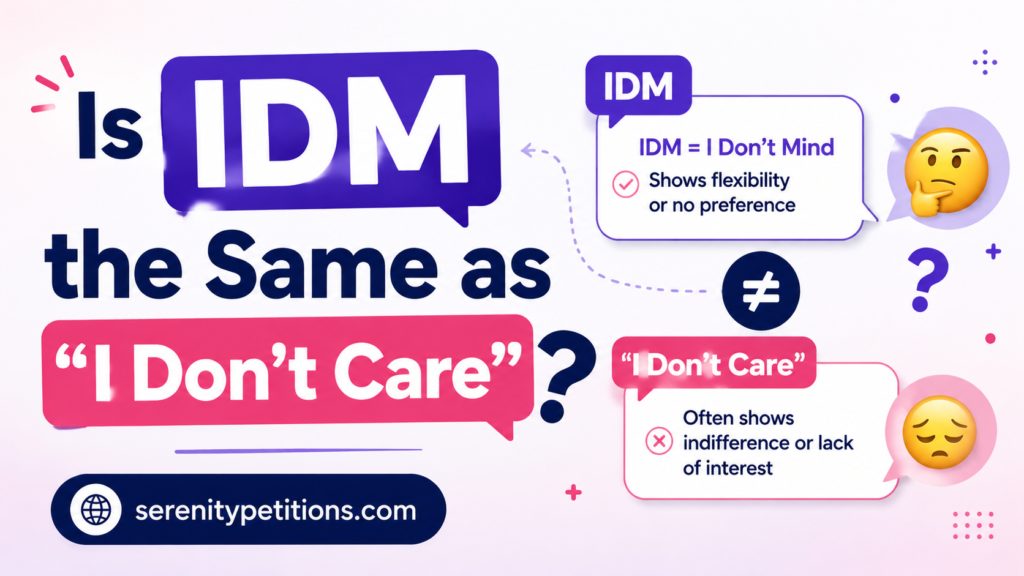
No, IDM and “I Don’t Care” are not exactly the same.
Although both phrases can sometimes suggest that a person has no preference, they usually have different tones.
IDM (I Don’t Mind) usually sounds:
I Don’t Care can sometimes sound:
Compare these examples:
Question: “Which restaurant should we try?”
Reply: “IDM.”
Meaning: “Any restaurant is fine with me.”
Reply: “I don’t care.”
Meaning: “I have no interest in choosing.” (This may sound rude depending on the situation.)
So, when someone says IDM in text, they usually mean:
“I’m okay with whatever works.”
They are not usually saying:
“I don’t care about the situation or the person.”
The tone depends on the conversation, relationship, and the way the message is written.
IDM and IDK are both common texting abbreviations, but they have completely different meanings.
IDM means “I Don’t Mind.” It shows that someone is okay with the available choices and does not have a strong preference.
IDK means “I Don’t Know.” It shows that someone does not have the answer or is unsure about something.
Here is the simple difference:
| Abbreviation | Full Form | Meaning |
| IDM | I Don’t Mind | I am okay with any option |
| IDK | I Don’t Know | I do not know the answer |
Examples:
Question: “Do you want pizza or tacos?”
Reply: “IDM.”
Meaning: “Either one is fine.”
Question: “What time does the movie start?”
Reply: “IDK.”
Meaning: “I don’t know.”
The easiest way to remember the difference is:
Although these abbreviations look similar, they are used in completely different situations.
IDM and IDC can be confusing because they look almost the same, but their meanings and tones are different.
IDM means “I Don’t Mind.” It usually sounds polite and shows acceptance.
IDC means “I Don’t Care.” It can sometimes sound more direct or dismissive, depending on the situation.
Here is the difference:
| Abbreviation | Full Form | Typical Tone |
| IDM | I Don’t Mind | Neutral, relaxed, accepting |
| IDC | I Don’t Care | Can sound blunt or uninterested |
Example:
Question: “Should we watch a comedy or an action movie?”
Reply: “IDM.”
Meaning: “Either movie works for me.”
Reply: “IDC.”
Meaning: “I don’t really care which one we watch.”
The main difference is the feeling behind the words. IDM usually shows flexibility, while IDC may sound like the person does not want to be involved in the decision.
However, the meaning can still depend on the person and the conversation. Some people use IDC casually without intending to sound rude, but IDM is generally the softer and more friendly expression.
IDM and “Whatever” can sometimes have a similar meaning because both may suggest that a person does not have a strong preference. However, the tone behind them can be different.
IDM (I Don’t Mind) usually sounds friendly and accepting. It means the person is okay with any option and is comfortable letting someone else choose.
Whatever can have different meanings depending on the situation. It may mean that any option is fine, but it can also sound bored, annoyed, or dismissive.
Here is the difference:
| Expression | Meaning | Typical Tone |
| IDM | I Don’t Mind | Relaxed, polite, accepting |
| Whatever | Any option is okay | Can be casual, bored, or dismissive |
Example:
Question: “What should we order?”
Reply: “IDM.”
Meaning: “You can choose. I’m fine with anything.”
Reply: “Whatever.”
Meaning could be:
The surrounding conversation matters. A person saying “whatever” may simply be relaxed, but in some situations, it can sound less friendly than IDM.
Usually, IDM is not rude.
The abbreviation is generally considered a neutral and casual way to show that someone is okay with something. It often communicates flexibility, agreement, or a willingness to let another person choose.
For example:
Person A: “Is it okay if we meet at 8 instead of 7?”
Person B: “IDM.”
This sounds like:
“That’s fine with me.”
However, the tone can depend on the situation. A very short reply like “IDM.” may sometimes feel a little cold if the conversation needs more emotion or explanation.
Compare:
“IDM.”
with:
“IDM, you can choose 😊.”
The second reply feels warmer because it gives more context.
IDM may not be the best response for questions that need a clear answer.
Example:
“Are you coming to my birthday party?”
“IDM.”
This does not clearly answer the question. A better response would be:
“Yes, I’d love to come.”
So, IDM itself is not rude, but it works best when the conversation is about choices, preferences, or whether something is acceptable.
Usually, IDM is not a flirty abbreviation. The common IDM meaning in text is simply “I Don’t Mind.” It normally shows that someone is okay with a choice or has no strong preference.
However, the meaning can feel different depending on the conversation and the relationship between the people.
For example:
Person A: “Want to get coffee sometime?”
Person B: “IDM.”
This could mean:
“I’m okay with that.”
But it does not automatically mean the person is interested romantically. The abbreviation alone is not a sign of flirting.
Another example:
Person A: “Movie at my place or yours?”
Person B: “IDM, you choose.”
The conversation may feel playful or flirty depending on the situation, but IDM itself still means “I Don’t Mind.”
When someone sends IDM, look at the full conversation instead of assuming it has a hidden meaning. The words before and after the abbreviation usually give the real clue.
On social media, IDM usually means “I Don’t Mind.” People use it in comments, direct messages, replies, and group chats to show that they are okay with something.
You may see IDM on platforms like:
For example:
Comment: “Should I upload part two?”
Reply: “IDM.”
This means:
“I don’t mind. Either choice is okay.”
Because social media conversations are often short, users prefer quick abbreviations like IDM. However, context is important because some online communities may use abbreviations differently.
On TikTok, IDM usually means “I Don’t Mind” when it appears in normal comments, replies, or messages.
For example:
Creator: “Should I make this video into a series?”
Comment: “IDM.”
This means:
“I don’t mind. Do what you think is best.”
TikTok users often use short slang and abbreviations because comments and messages move quickly. Still, slang can change between different communities, so it is always best to check the surrounding conversation.
If the message is about choosing something, accepting an idea, or giving permission, IDM most likely means “I Don’t Mind.”
On Snapchat, IDM usually means “I Don’t Mind.” People often use it as a quick reply when they are okay with a suggestion, plan, or choice.
Snapchat conversations are usually short, so users often prefer simple abbreviations instead of typing complete sentences.
Example:
Person A: “Want to snap later?”
Person B: “IDM.”
This means:
“I don’t mind.”
or
“Sure, that’s fine with me.”
Another example:
Person A: “Should we send streaks now or later?”
Person B: “IDM.”
Here, the person is saying that either option works.
However, if IDM appears in a message where choosing or accepting something does not make sense, the surrounding conversation should be checked to understand the intended meaning.
On Instagram, IDM usually means “I Don’t Mind.” It can appear in DMs, comments, story replies, and group conversations.
People use it when they want to show that they are comfortable with a choice or do not have a strong opinion.
Example:
Person A: “Can I tag you in my post?”
Person B: “IDM.”
This means:
“I don’t mind. That’s okay.”
Another example:
Person A: “Should I post the blue outfit or the black one?”
Person B: “IDM.”
Here, the person is saying they are fine with either option.
Because Instagram messages are often casual, IDM fits naturally in friendly conversations. In formal situations, writing the full phrase “I don’t mind” may be clearer.
On WhatsApp, IDM means “I Don’t Mind.” Users commonly use it in personal chats, family groups, and friend groups when discussing plans or making decisions.
For example:
Person A: “Are we meeting at 5 or 6?”
Person B: “IDM, both work for me.”
This means:
“I’m okay with either time.”
Another example:
Person A: “Can we change the meeting place?”
Person B: “IDM.”
Here, the person accepts the change.
WhatsApp users often use abbreviations to make conversations faster, but not everyone may understand texting slang. If clarity is important, especially in mixed-age groups or important discussions, writing “I don’t mind” is usually better.
On Discord, IDM usually means “I Don’t Mind.” People often use it in casual conversations, gaming servers, and community chats when they do not have a preference.
Discord messages are usually fast and informal, so users often rely on short abbreviations like IDM to keep conversations moving.
Example:
Player 1: “Which channel should we use?”
Player 2: “IDM.”
This means:
“I don’t mind. Any channel is fine.”
Another example:
User 1: “Should we start the discussion now or later?”
User 2: “IDM, you decide.”
Here, the person is allowing the other person to choose.
However, Discord has many different communities, and some servers may create their own slang. If IDM appears in a specific community where the usual meaning does not fit, check the context before assuming its meaning.
In gaming chats, IDM usually means “I Don’t Mind.” Players use it when they are okay with different choices, such as game modes, roles, maps, or strategies.
Gaming conversations often move quickly, so short abbreviations help players communicate faster.
Examples:
Player 1: “Ranked or casual?”
Player 2: “IDM.”
Meaning:
“Either game mode is fine.”
Another example:
Player 1: “Do you want to play support or attack?”
Player 2: “IDM, you choose.”
Meaning:
“I’m okay with either role.”
In gaming, IDM usually shows flexibility and teamwork. It helps players avoid wasting time on small decisions and focus on playing.
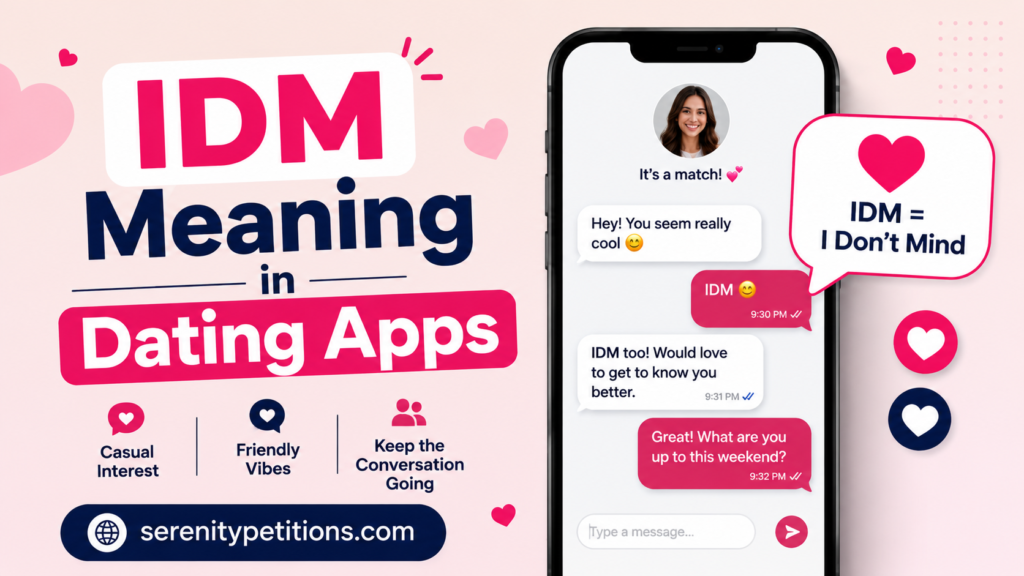
On dating apps, IDM still usually means “I Don’t Mind,” but the meaning can sometimes be harder to understand because text messages do not show facial expressions or tone.
For example:
Person A: “Coffee or dinner?”
Person B: “IDM.”
This most likely means:
“Either option works for me.”
However, a short reply like IDM can sometimes feel less enthusiastic, depending on the conversation. It does not automatically mean the person is uninterested or interested.
For example:
Person A: “Want to meet this weekend?”
Person B: “IDM.”
This could simply mean they are open to meeting, but more context is needed to understand their feelings.
The abbreviation itself is not a secret dating signal. The overall conversation, effort, and communication style matter more than the word IDM alone.
In professional messaging, IDM is usually better suited for casual workplace conversations rather than formal communication. While some teams may use texting abbreviations in internal chats, not everyone may understand what IDM means.
For example, in a relaxed team chat:
Coworker: “Should we meet at 2 or 3?”
You: “IDM, both times work.”
This can be acceptable because the conversation is informal.
However, in a formal email or professional message, it is better to use complete phrases instead of abbreviations.
Instead of writing:
“IDM.”
You can write:
“Either time works for me.”
or:
“I’m happy with whichever option is most convenient.”
Using clear language helps avoid confusion, especially when communicating with clients, managers, or people who may not be familiar with internet slang.
You can use IDM Meaning in Text when the conversation is casual and you genuinely do not have a strong preference.
IDM works well when:
Example:
Friend: “Movie or bowling tonight?”
You: “IDM, you choose.”
This sounds natural because you are showing that either option is fine.
Another example:
Friend: “Can we meet at 8 instead of 7?”
You: “IDM.”
Here, IDM clearly means that the change is acceptable.
You should avoid using IDM when the question needs a clear answer, a personal opinion, or an emotional response.
For example:
Question: “Are you coming to my birthday party?”
Reply: “IDM.”
This does not clearly answer the question.
A better response would be:
You should also avoid IDM in:
Although IDM is a simple and harmless abbreviation, using full words is often better when clarity matters. The right choice depends on the situation, the person you are talking to, and the tone of the conversation.
Although IDM meaning in text is simple, people sometimes misunderstand how and when to use it. Because it looks similar to other abbreviations, it can create confusion.
Here are some common mistakes people make with IDM:
IDM and IDK look similar, but they have completely different meanings.
For example:
“Do you want tea or coffee?”
“IDM.”
This means: “Either one is fine.”
“Where is John?”
“IDK.”
This means: “I don’t know.”
Some people think IDM and “I don’t care” mean the same thing, but they have different tones.
IDM usually sounds accepting and relaxed.
I don’t care can sometimes sound uninterested or rude.
When someone says IDM, they are usually saying:
“I’m okay with whatever works.”
They are not usually saying that they do not care about the person or situation.
IDM works best when someone asks about choices, preferences, or permission.
It does not work as an answer to every question.
For example:
“Are you ready for the meeting?”
“IDM.”
This does not make sense because the question needs a clear response.
IDM is not automatically a romantic or flirty abbreviation.
The phrase simply means “I Don’t Mind.” The rest of the conversation determines whether there is any romantic meaning.
A short reply like:
“IDM.”
can feel neutral or slightly cold depending on the situation.
A reply like:
“IDM, you can choose 😊.”
sounds warmer and more friendly.
The meaning of IDM depends on the conversation, timing, and relationship between the people.
Your reply to IDM depends on the situation and what the person means.
If they are saying that either option is fine, you can simply make the decision yourself.
Example:
Person A: “Pizza or burgers?”
Person B: “IDM.”
Reply: “Cool, let’s go with pizza.”
If you want to confirm what they mean, you can ask:
“So either one works for you?”
If the choice matters to you, you can move the conversation forward:
“Okay, I’ll choose then.”
If you are unsure about their meaning, ask for clarification:
“Do you mean you don’t mind which one we pick?”
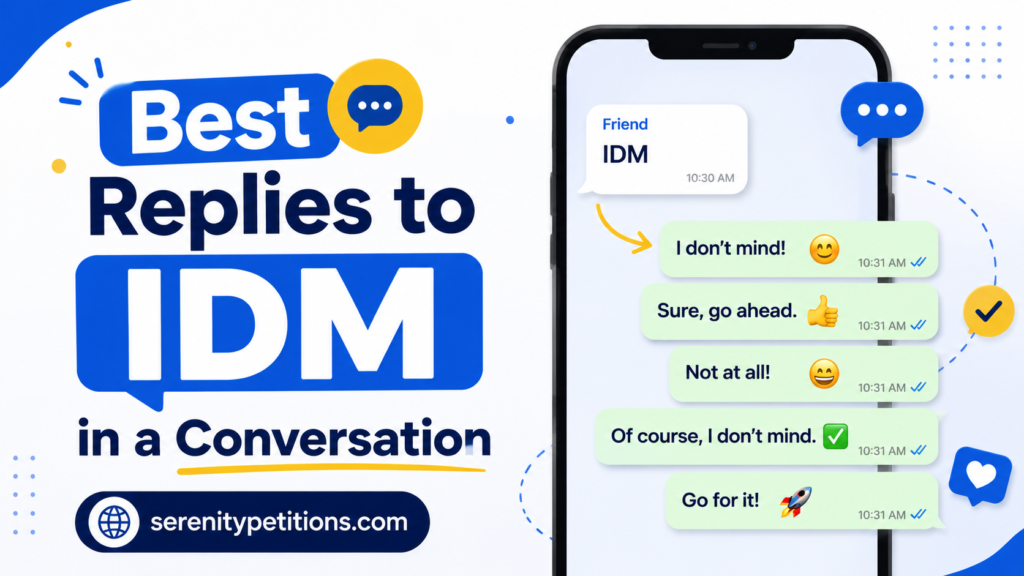
Here are some natural replies:
The best response depends on the situation, but there is usually no need to overthink IDM. It simply means the person is okay with the options being discussed.
When someone says IDM Meaning in Text, they usually mean “I Don’t Mind” and are giving you the freedom to choose. Your reply depends on the situation and the type of conversation.
Here are some natural replies you can use:
“Cool, I’ll pick.”
This works when someone lets you decide between different options.
“Nice, that makes my decision easier.”
This keeps the conversation positive and relaxed.
“Careful, I’m choosing the weirdest option then.”
This adds humor and makes the chat more fun.
“Perfect, then I’m choosing the place with the best dessert.”
This can work in a playful conversation, but the flirty meaning comes from the overall conversation, not IDM itself.
“Got it. Either option works for you.”
This is useful when you want to confirm what the person means.
The goal of replying to IDM is to continue the conversation instead of getting stuck on the abbreviation.
IDM is one of many common texting abbreviations. Some of them may look similar, but each one has a different meaning.
| Abbreviation | Meaning | Example |
| IDM | I Don’t Mind | “Pizza or tacos?” — “IDM.” |
| IDK | I Don’t Know | “Where is he?” — “IDK.” |
| IDC | I Don’t Care | “What should we watch?” — “IDC.” |
| IK | I Know | “That movie is good.” — “IK.” |
| IMO | In My Opinion | “IMO, the first option is better.” |
| TBH | To Be Honest | “TBH, I like the second one.” |
| NVM | Never Mind | “NVM, I solved it.” |
| WTV | Whatever | “WTV, you choose.” |
The biggest difference is that IDM shows acceptance or no preference, while other abbreviations may show uncertainty, knowledge, opinions, or a lack of interest.
For example:
“Pizza or burgers?”
Understanding these differences helps you use the right abbreviation in the right situation.
The IDM meaning in text is usually “I Don’t Mind.” In a sentence, it shows that someone is okay with a choice, accepts a situation, or does not have a strong preference.
Here are some simple examples:
“I asked her if she wanted tea or coffee, and she said IDM.”
Meaning: She was okay with either drink and did not prefer one over the other.
“He said IDM when I asked which restaurant he wanted to visit.”
Meaning: He did not have a favorite restaurant and allowed someone else to choose.
“I asked if we could change the meeting time, and they replied IDM.”
Meaning: They were okay with the new time.
“She said IDM, so I picked the movie.”
Meaning: She was comfortable letting the other person decide.
In most sentences, IDM expresses flexibility and acceptance. The exact meaning depends on the situation and the words around it.
Yes, abbreviations can sometimes have different meanings depending on the context, industry, or online community.
However, in normal texting, chats, and social media conversations, IDM most commonly means “I Don’t Mind.”
Other possible meanings may appear in:
These meanings are usually less common and depend heavily on the topic being discussed.
To understand what IDM means in a specific message, look at:
For example:
“Do you want pizza or burgers?”
“IDM.”
The meaning is clear:
“I don’t mind. Either option is okay.”
But if IDM appears in a technical conversation and “I Don’t Mind” does not make sense, the abbreviation may have another meaning.
In everyday messages, though, IDM usually means “I Don’t Mind.”
The IDM meaning in text is usually “I Don’t Mind,” but the exact feeling behind it can change depending on the conversation.
Because IDM is a short reply, the messages before and after it often explain what the person really means.
Compare these examples:
Person A: “Do you want pizza or burgers?”
Person B: “IDM.”
Meaning: Either food choice is fine.
Person A: “Are you upset with me?”
Person B: “IDM.”
This sounds unusual because IDM does not clearly answer an emotional question.
Person A: “Do you mind if I leave early?”
Person B: “IDM.”
Meaning: “I don’t mind. That’s okay.”
The same abbreviation can feel natural in one situation and confusing in another. The topic, relationship between the people, and tone of the conversation all help determine the intended meaning.
IDM is usually a neutral to slightly positive expression.
It often shows that someone is:
For example:
“Should we watch a comedy or an action movie?”
“IDM.”
This sounds relaxed because the person is saying either option works.
However, a short reply can sometimes feel less enthusiastic if the situation needs more emotion.
Example:
“I planned a surprise for you. Is that okay?”
“IDM.”
This may sound too casual because the situation might need a warmer response, such as:
“That sounds great!”
The abbreviation itself is not negative, but the situation and tone can change how it feels.
Not necessarily.
IDM Meaning in Text is more common among people who frequently use online communication, social media, gaming chats, and messaging apps.
Many people are familiar with common abbreviations like:
However, less common abbreviations like IDM may not be understood by everyone.
For example:
When talking with someone who may not understand abbreviations, writing the full phrase “I don’t mind” is usually clearer.
The best choice depends on the person you are messaging and the situation. In casual chats, IDM works well, but in formal or important conversations, using complete words is often better.
IDM Meaning in Text stands for I Don’t Mind. It means someone is okay with a choice and does not have a strong preference.
No, they are different. IDM means I Don’t Mind, while IDK means I Don’t Know in chats.
Usually, IDM Meaning in Text is not rude. It sounds casual and shows that someone accepts different options.
Yes, people use IDM on social platforms, messages, and comments to show they are fine with something.
No, IDM Meaning in Text is softer than I don’t care. It usually means someone is relaxed about a decision.
IDM Meaning in Text is not normally flirty. Its meaning depends on the conversation and the relationship between people.
You can choose an option or continue the conversation. A simple reply like I’ll pick works well.
IDM Meaning in Text is a simple way to understand online chats. IDM Meaning in Text usually means I Don’t Mind. It shows that someone is okay with a choice. It is a common and friendly texting abbreviation.
IDM Meaning in Text helps users understand short replies on social media and messages. Other slang terms like bffr meaning, myf meaning in text, and what does wyll mean also appear in online conversations.
Knowing these abbreviations makes chats easier to follow. IDM meaning in text is different from what myf means, because each slang word has its own meaning. Always check the conversation context before understanding any abbreviation.