Physical Address
304 North Cardinal St.
Dorchester Center, MA 02124
Physical Address
304 North Cardinal St.
Dorchester Center, MA 02124

The internet has a language of its own, and one unfamiliar word can leave you wondering what someone really means. If you’ve recently seen solti meaning in a text, comment, or social media post, you’re probably not alone. Slang can change quickly, and context often matters more than the word itself.
In this guide, you’ll learn what Solti meaning and how people may use it in everyday online conversations. We’ll also look at related searches such as dipsy meaning, yeoh meaning, and syfm meaning. These Solti meaning can appear confusing at first, especially when you see them without any explanation or background.
You’ll also find a simple explanation of what does ts mean in text and how tone can change an expression’s meaning. By the end, you’ll have a clearer idea of how these casual terms work and when people commonly use them.
solti meaning is an informal Nepali term commonly used to address another person in a friendly or familiar way. In English, words such as friend, buddy, bro, or mate can express a similar idea.
For example:
“Solti, are you coming with us?”
Here, the speaker isn’t asking for a formal response. They’re simply addressing someone they know in a casual way.
The exact feeling can shift slightly. Between close friends, it may sound warm and playful. In a casual online comment, it may simply be an informal way to address another person.
| Detail | Explanation |
| Common meaning | Friend, buddy, bro, or familiar person |
| Language association | Nepali informal speech |
| Type of word | Colloquial expression |
| Tone | Usually casual and friendly |
| Common use | Chats, comments, social media, everyday conversation |
| Formality | Informal |

The main solti meaning is a friendly way to refer to or address someone. It doesn’t usually describe a particular object, action, or abbreviation. Instead, it works more like a casual form of address.
Imagine a friend saying, “Hey, buddy!” The word solti can serve a similar purpose in an informal Nepali-speaking context.
For example:
“Thanks, solti. I really needed that.”
The speaker is expressing appreciation while keeping the conversation relaxed.
Another example might be:
“Solti, let’s grab something to eat.”
Here, the word creates a friendly tone rather than changing the basic meaning of the sentence.
Solti generally keeps the same basic idea, but its emotional meaning can change with context. A speaker might use it warmly, jokingly, or while lightly teasing someone.
| Situation | Possible sense | Tone |
| Talking with a close friend | Buddy or bro | Warm |
| Greeting someone casually | Friend or familiar person | Relaxed |
| Making a joke | Playful nickname | Humorous |
| Lightly teasing someone | Familiar form of address | Teasing |
| Starting a serious conversation | Familiar way to address someone | Neutral or serious |
It’s important not to assume that every use carries exactly the same emotion. The surrounding words usually provide the missing clue.
There also isn’t a standard English-style “full form” that solti commonly represents. It isn’t normally used as an acronym.
The solti meaning in conversation depends heavily on the situation. The same word can sound completely different when the surrounding message changes.
Consider these examples:
Example 1: Friendly invitation
“Solti, want to get coffee later?”
This sounds like a relaxed invitation between people who are familiar with each other.
Example 2: Checking on someone
“What happened, solti?”
The speaker may be showing concern or simply asking what went wrong.
Example 3: Playful teasing
“You forgot your keys again, solti 😂”
The laughing emoji makes the message feel more playful.
Example 4: Serious discussion
“Listen, solti. We need to talk.”
Here, the word still sounds familiar, but the sentence that follows makes the overall tone more serious.
When you’re trying to understand what does solti mean, look at:
The word can appear across several platforms, particularly in casual conversations and communities where Nepali language or culture is common. However, the platform itself doesn’t automatically create a new definition.
In private messages, solti meaning in text is usually easy to understand from the conversation. It can work much like “bro” or “buddy.”
For example:
“Morning, solti! Are you ready for class?”
The message sounds casual and familiar.
If someone sends only “Solti 😂,” you’ll need the earlier messages to understand whether they’re greeting you, joking with you, or calling your attention.
On Facebook and Instagram, people may use solti when commenting on a friend’s post or responding to someone they know.
For example:
“Looking great, solti!”
Or:
“Nice one, solti 😂”
In these cases, it works as a friendly form of address. The comment may be supportive, humorous, or simply conversational.
On TikTok, solti meaning generally remains connected to its informal use rather than becoming a completely different slang term.
You may encounter it in comments, captions, jokes, or videos involving Nepali speakers. The surrounding content still matters, especially when a comment is sarcastic or humorous.
For example:
“Bro really did that, solti 😂”
The phrase may carry a playful tone because of the wording and emoji.
Seeing the term in actual conversations makes its use much easier to understand. Here are a few natural examples.
Person A: “Solti, where are you?”
Person B: “I’m five minutes away.”
Meaning: The speaker is casually checking where their friend is.
Person A: “That game was crazy, solti!”
Person B: “I know! That last goal was wild.”
Meaning: The word adds a familiar, friendly feeling to the conversation.
Person A: “New picture 😎”
Person B: “Looking good, solti!”
Meaning: The commenter is giving friendly praise in an informal way.
These examples show why context matters. The word itself stays familiar, while the surrounding conversation determines the exact tone.
The emotional side of solti meaning isn’t fixed. It can sound warm in one conversation and teasing in another.
That’s normal with informal language. Words like “bro,” “dude,” and “buddy” can also change tone depending on how people use them.
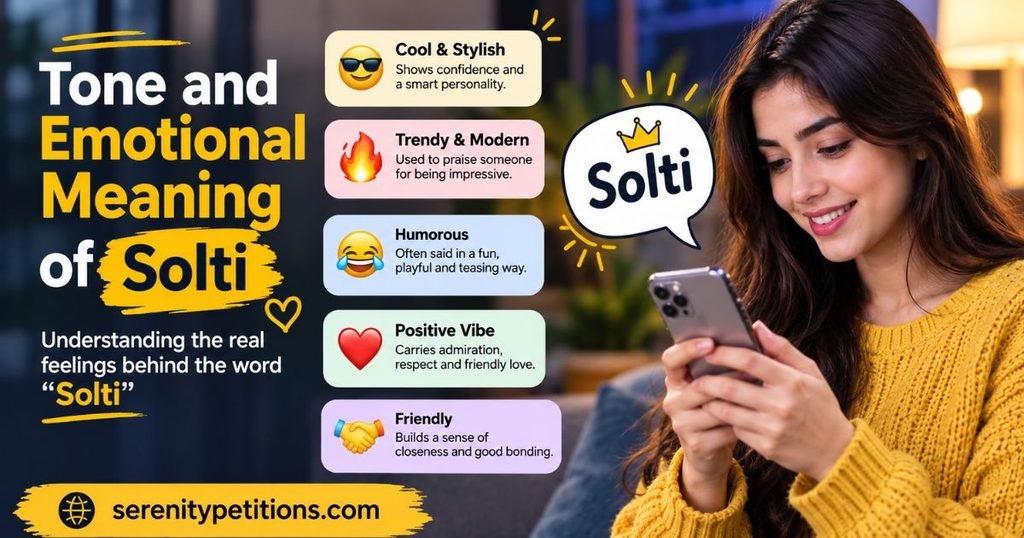
Usually, solti isn’t considered rude when used appropriately in an informal setting.
However, familiarity matters. Calling a stranger “solti” may sound overly casual if they aren’t comfortable with the expression.
The safest approach is simple: consider your relationship with the person before using informal slang.
It can definitely be playful or funny.
Friends may use it while teasing each other, especially when they add laughing emojis or exaggerate the situation.
For example:
“You’re late again, solti 😂”
The humor comes from the situation, not from the word itself.
Solti isn’t inherently offensive. Its tone depends on the surrounding message and the relationship between the speakers.
For instance, “Thanks, solti!” sounds friendly. A sarcastic sentence using the same word could feel less friendly.
So, don’t judge the word alone. Read the whole message.
If someone calls you solti, you don’t need a special response. A normal, relaxed reply usually works best.
Your response can match their tone. If they’re joking, you can joke back. If they’re simply greeting you, respond normally.
You could say:
These replies keep the conversation natural without overthinking the slang.
If the conversation is playful, try something more humorous:
The best reply depends on your relationship and the mood of the conversation.
If you’ve never heard the word before, there’s nothing wrong with asking.
Try:
A quick question can clear up the meaning without creating confusion.
You can use solti meaning when the setting feels relaxed and the other person understands the expression.
It may fit naturally in:
If you’re unsure whether someone knows the term, using their name or a more familiar English word may be clearer.
Although the term is generally casual rather than offensive, it isn’t suitable for every situation.
Avoid relying on it in settings such as:
In these situations, clear and respectful language creates a better impression.
For example, instead of writing “Hey, solti” in a professional email, use the person’s name or an appropriate greeting.
People can misunderstand slang when they assume every informal word has one fixed definition. With solti meaning, context matters.
Here are a few common mistakes to avoid:
| Mistake | Better understanding |
| Treating solti as an acronym | It’s generally used as a colloquial word, not an acronym |
| Assuming it always means “bro” | Friend, buddy, or familiar address can all fit |
| Using it with everyone | Familiarity and context matter |
| Assuming the word is automatically funny | Humor comes from the surrounding conversation |
| Using it in formal writing | A standard greeting is usually more appropriate |
Another common mistake is judging the word without reading the rest of the message. Emojis, punctuation, and phrasing can completely change the tone.
If you’re familiar with English slang, several words have a similar conversational function.
| Term | General meaning | Typical feel |
| Bro | Friend or brother-like person | Very casual |
| Buddy | Friend | Friendly |
| Mate | Friend or companion | Casual |
| Dude | Casual way to address someone | Relaxed |
| Homie | Close friend | Very informal |
These aren’t perfect translations in every situation. They simply help explain the role solti can play in a conversation.
The closest choice depends on the relationship, setting, and language being used.
solti meaning is associated with informal Nepali speech and has been used as a familiar way to address another person. Its everyday use isn’t limited to modern social media.
As conversations move between languages, local expressions can also appear in English-language chats. That’s one reason you may notice terms like solti in comments, memes, short videos, and messaging apps.
Its online appearance doesn’t necessarily mean the word has gained a new definition. Often, people are simply bringing a familiar spoken expression into digital communication.
People often choose informal words because they make messages feel more personal. A simple greeting can sound warmer when it reflects the speaker’s usual way of talking.
Solti can help create that relaxed feeling. It may signal familiarity without requiring a long explanation.
For example:
“Hey, solti! Long time no see.”
Compared with a formal greeting, the message feels more natural between friends.
However, slang only works well when both sides understand the tone. That’s why context remains important.
The same expression can feel slightly different depending on the people involved.
Among friends, solti can sound warm and natural. It may appear at the beginning of a message, in a greeting, or while making plans.
“Solti, let’s meet after class.”
The word simply makes the invitation feel more relaxed.
Close friends may use solti while joking, teasing, or checking on each other.
“You really forgot again, solti? 😂”
The message isn’t necessarily hostile. The relationship and laughing emoji suggest playful teasing.
Online, solti may appear in comments, jokes, captions, or meme-related conversations. The meaning still depends on the surrounding content.
A short comment such as “Nice one, solti!” usually sounds supportive. A sarcastic meme may give the same word a more teasing feel.

Here’s the short version:
In short, if a friend calls you “solti,” they’re usually speaking to you in a casual, familiar way.
Solti usually means friend, buddy, or bro in informal Nepali speech and online conversations, depending on the relationship and context.
Solti isn’t normally an acronym or abbreviation. It’s a colloquial Nepali term used as a familiar way to address someone.
On TikTok, solti generally keeps its friendly meaning, especially in Nepali communities, comments, jokes, videos, and casual interactions online today.
You can reply naturally with a greeting, joke, or question. Match the speaker’s tone instead of switching to formal language.
Yes. Solti can sound friendly, playful, teasing, or slightly serious depending on wording, punctuation, emojis, and your relationship with someone.
Use solti with friends, classmates, or familiar people when casual language fits the conversation and everyone understands the expression clearly.
Avoid solti in formal emails, professional messages, academic writing, or unfamiliar settings where a person’s name or polite greeting works.
Understanding slang becomes much easier when you look at the full conversation. The solti meaning usually points to a friendly or familiar way of addressing someone. It can feel like saying “bro,” “buddy,” or “friend.” Still, tone matters. A joke, emoji, or serious message can change how the word feels.
If you’re researching online expressions, you may also come across dipsy meaning, yeoh meaning, and syfm meaning. These solti meaning can look confusing when you first see them. However, checking the context usually makes their intended meaning clearer. The same idea applies across different social media platforms.
You may also wonder, what does ts mean in text when you see it in messages or comments. Internet language changes quickly, but you don’t need to memorize every term. Look at the surrounding words, consider the relationship, and notice the tone. That simple approach can help you understand unfamiliar slang without guessing.