Physical Address
304 North Cardinal St.
Dorchester Center, MA 02124
Physical Address
304 North Cardinal St.
Dorchester Center, MA 02124
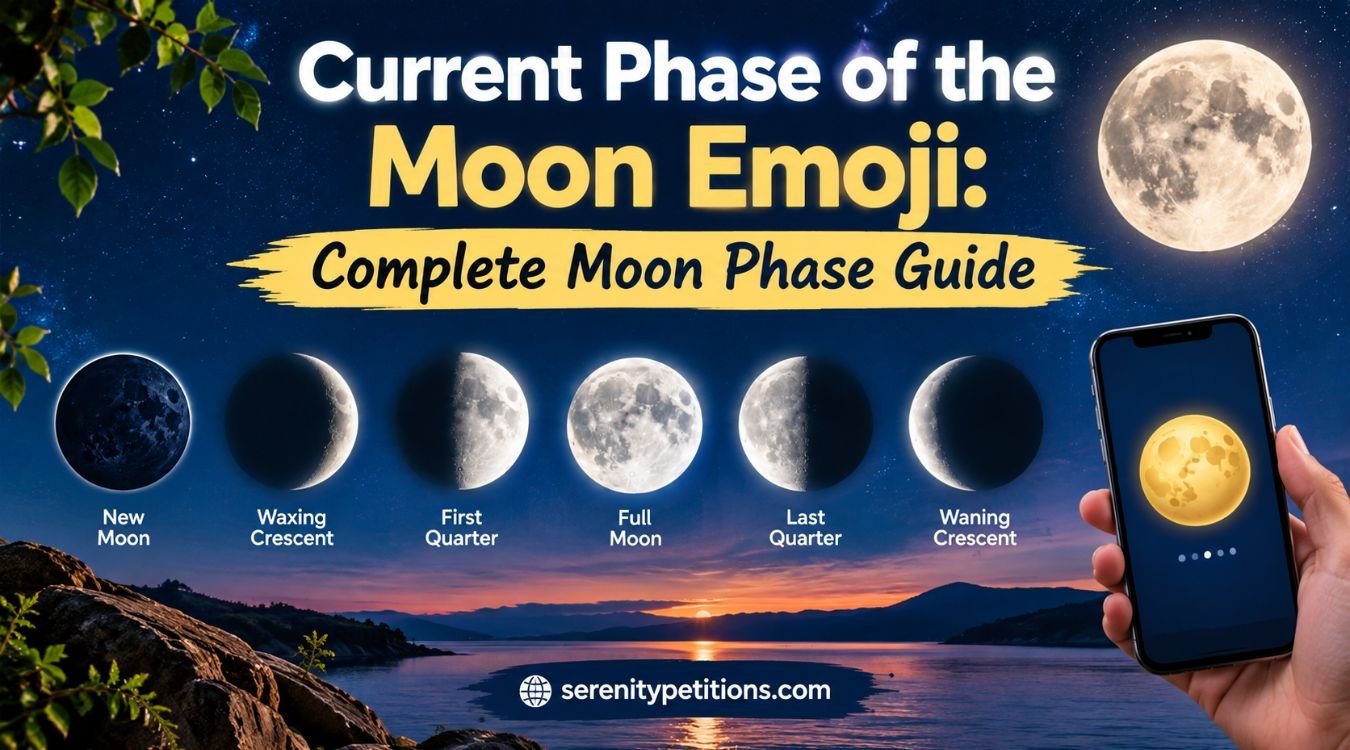
Have you ever checked the Moon outside and wondered which emoji actually matches what you’re seeing? 🌙 It sounds simple, but the answer changes as the Moon moves through its lunar cycle.
The current phase of the moon emoji depends on the Moon’s real astronomical phase at a particular date and time. There are eight commonly recognized Moon phases, and each has a matching Unicode emoji, from the dark New Moon 🌑 to the bright Full Moon 🌕.
As of September 26, 2026, the Moon is reaching its Full Moon phase. In Multan, Pakistan, the Full Moon occurs at about 9:49 PM local time, making 🌕 the matching moon phase emoji around the peak of the event.
The important part is that Moon emojis are not live indicators. They are fixed symbols. So, if you want the moon phase emoji today, you first need to identify today’s lunar phase and then choose the corresponding emoji.
The current phase of the moon emoji for September 26, 2026, is 🌕 Full Moon around the Full Moon event. In Multan, the Full Moon reaches its peak at approximately 9:49 PM local time.
The eight major moon phase emojis are:
Because the Moon changes continuously, the today’s moon phase emoji can be different from yesterday’s or tomorrow’s.
If you need an exact answer for another date, use a current lunar calendar rather than relying on an old article or saved screenshot.
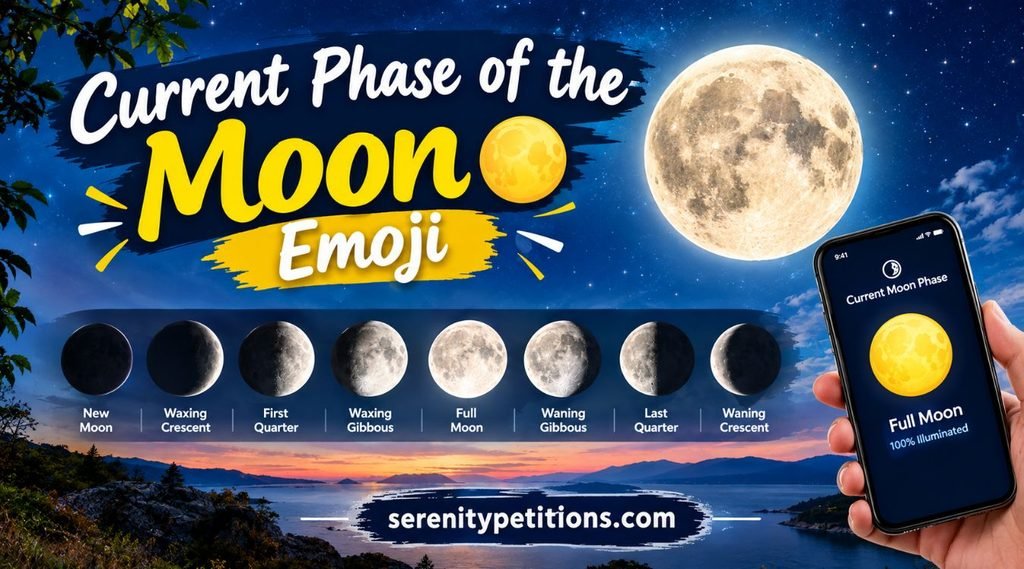
The easiest way to understand the current moon phase emoji is to see how each symbol fits into the larger lunar cycle.
| Moon Phase | Emoji | Illumination Pattern | Basic Meaning |
| New Moon | 🌑 | Almost completely dark | Start of the lunar cycle |
| Waxing Crescent | 🌒 | Small illuminated crescent grows | Light is increasing |
| First Quarter | 🌓 | About half illuminated | Waxing continues |
| Waxing Gibbous | 🌔 | More than half illuminated | Approaching Full Moon |
| Full Moon | 🌕 | Nearly the entire visible face is lit | Peak illumination |
| Waning Gibbous | 🌖 | More than half illuminated | Light is decreasing |
| Last Quarter | 🌗 | About half illuminated | Waning continues |
| Waning Crescent | 🌘 | Thin illuminated crescent | Cycle is nearing New Moon |
Think of the sequence as a gradual rise and fall in visible sunlight.
The Moon becomes brighter from 🌑 toward 🌕. After Full Moon, the illuminated portion begins shrinking until 🌑 starts the cycle again.
current phase of the moon emoji can look similar at first glance. The trick is to pay attention to two things: how much of the Moon is illuminated and whether the illuminated portion is increasing or decreasing.
For example, 🌔 and 🌖 are both gibbous Moon emojis, but they occur on opposite sides of the Full Moon. Likewise, 🌒 and 🌘 are both crescents, but one belongs to the waxing part of the cycle while the other belongs to the waning part.
Waxing means the illuminated portion is growing. Waning means it is shrinking.
The main waxing moon emojis are:
The main waning moon emojis are:
A simple memory trick works well: waxing moves toward 🌕, while waning moves away from 🌕.
So, if the current phase of the moon emoji is becoming more illuminated each night, you need a waxing moon emoji. If the visible light is decreasing, choose a waning symbol instead.
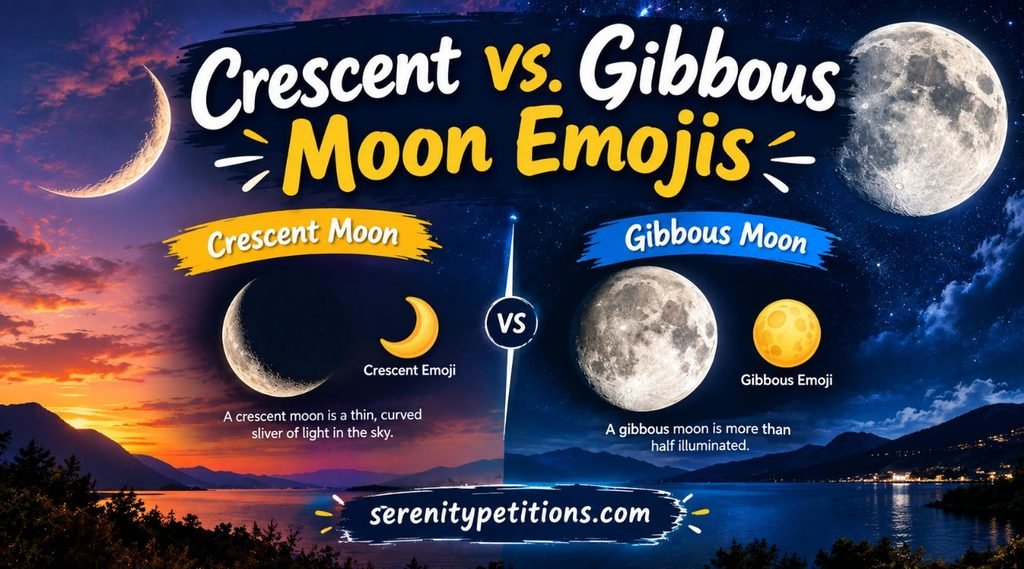
The words crescent and gibbous describe how much of the visible lunar disk is illuminated.
A crescent has less than half of the visible Moon illuminated. That gives you 🌒 and 🌘.
A gibbous Moon has more than half illuminated but is not yet completely full. Those phases are 🌔 and 🌖.
This distinction makes the moon phase emoji chart much easier to read. First decide whether the Moon looks less than half lit or more than half lit. Then determine whether it is waxing or waning.
The First Quarter 🌓 and Last Quarter 🌗 can be confusing because both show roughly half of the Moon illuminated.
The difference is where they occur in the lunar cycle.
First Quarter 🌓 comes after the Waxing Crescent and before the Waxing Gibbous. The Moon is moving toward Full Moon.
Last Quarter 🌗 comes after the Waning Gibbous and before the Waning Crescent. The Moon is moving away from Full Moon.
So, the word “quarter” describes the Moon’s position in its orbit around Earth, not the amount of visible light.
The phrase current phase of the moon as an emoji simply means choosing the emoji that most closely represents the Moon’s present astronomical phase.
There is no special live emoji that changes automatically with the sky. Instead, you identify the real lunar phase and select its matching Unicode symbol.
For example:
This distinction matters when someone searches for a real-time moon phase emoji. The emoji itself is not real-time. Your selection is based on real-time astronomical information.
Here is a simple reference for the full set of moon phase emojis:
| Lunar Phase | Emoji | What You See | Cycle |
| New Moon | 🌑 | Little to no visible illumination | Beginning |
| Waxing Crescent | 🌒 | Thin bright crescent | Growing |
| First Quarter | 🌓 | Roughly half illuminated | Growing |
| Waxing Gibbous | 🌔 | More than half illuminated | Growing |
| Full Moon | 🌕 | Almost completely illuminated | Peak |
| Waning Gibbous | 🌖 | More than half illuminated | Shrinking |
| Last Quarter | 🌗 | Roughly half illuminated | Shrinking |
| Waning Crescent | 🌘 | Thin fading crescent | Shrinking |
You can also copy and paste the complete lunar sequence:
🌑 🌒 🌓 🌔 🌕 🌖 🌗 🌘
These are useful as moon phase symbols, especially for social posts, notes, messages, journals, and astronomy-related content.
The New Moon emoji 🌑 represents the beginning of a lunar cycle.
During a New Moon, the Moon is positioned roughly between Earth and the Sun. The side facing Earth receives very little direct sunlight, so the Moon is difficult or impossible to see with the naked eye under normal conditions.
Astronomically, 🌑 represents a specific lunar phase. In everyday communication, however, people may use it more creatively.
Common associations include:
For example, someone beginning a new chapter might write, “Starting over 🌑.” In that situation, the emoji is being used symbolically rather than as an exact astronomy reference.
The Waxing Crescent emoji 🌒 represents the early stage after New Moon.
A small portion of the Moon becomes illuminated, and that bright portion continues growing. The Moon is still mostly dark, but its visible light increases night by night.
The term waxing is the important clue. It tells you that illumination is increasing.
You might see 🌒 used for ideas such as:
If you are looking for a matching moon phase emoji after the New Moon, 🌒 is the symbol to consider when the visible illuminated portion is still a crescent and growing.
The First Quarter emoji 🌓 represents the point where roughly half of the Moon’s visible disk is illuminated.
The name can be misleading. It does not mean that only one-quarter of the Moon looks bright.
Instead, “First Quarter” refers to the Moon being approximately one-quarter of the way through its complete lunar cycle.
This phase falls between the Waxing Crescent and Waxing Gibbous.
People may also use 🌓 symbolically for:
From an astronomy perspective, however, its main job is simple: it identifies the First Quarter phase.
The Waxing Gibbous emoji 🌔 appears when more than half of the visible Moon is illuminated, but the Moon has not reached Full Moon yet.
The illuminated area continues growing.
This makes 🌔 easy to place in the lunar cycle. It comes after 🌓 and immediately before 🌕.
If you are trying to identify the current lunar phase emoji, look at the Moon’s illuminated portion. If more than half is bright and the light is still increasing, Waxing Gibbous is the appropriate phase.
In casual messages, 🌔 can also suggest anticipation or something approaching completion.
The Full Moon emoji 🌕 is the most recognizable of the eight major Moon phase symbols.
It represents the point when the Moon appears fully illuminated from Earth. This happens when Earth is positioned approximately between the Sun and Moon.
The Moon does not create its own visible light. Sunlight reflects from its surface and reaches Earth.
The 🌕 emoji commonly appears in:
On September 26, 2026, the Full Moon reaches its peak at approximately 9:49 PM local time in Multan.
So, for someone asking for the moon phase emoji today on that date, 🌕 is the natural match around the Full Moon event.
The Waning Gibbous emoji 🌖 represents the stage after Full Moon.
More than half of the Moon remains illuminated, but the visible bright portion is now decreasing.
This is where many people mix up 🌔 and 🌖. Both are gibbous, but their direction is different:
The word waning is your clue that illumination is shrinking.
People may also use 🌖 to represent reflection, transition, slowing down, or moving beyond a major moment.
The Last Quarter emoji 🌗 appears when roughly half of the Moon is illuminated during the waning half of the lunar cycle.
It looks similar to the First Quarter emoji, but the cycle direction is different.
The easiest comparison is:
🌓 = half-lit Moon before Full Moon
🌗 = half-lit Moon after Full Moon
This phase is sometimes associated symbolically with change, adjustment, or finishing a process. Astronomically, though, it simply marks the Last Quarter stage of the lunar cycle.
The Waning Crescent emoji 🌘 represents the final major phase before the cycle returns to New Moon.
Only a narrow portion of the visible Moon remains illuminated, and that illuminated portion continues shrinking.
It comes after the Last Quarter phase and immediately before New Moon.
The emoji can be used for:
Once the cycle reaches the New Moon again, 🌑 starts the sequence over.
The lunar cycle happens because the Moon orbits Earth while sunlight illuminates half of its surface.
As the Moon changes position relative to Earth and the Sun, we see different portions of that illuminated half.
The Moon itself does not turn into different shapes. It remains a roughly spherical celestial body.
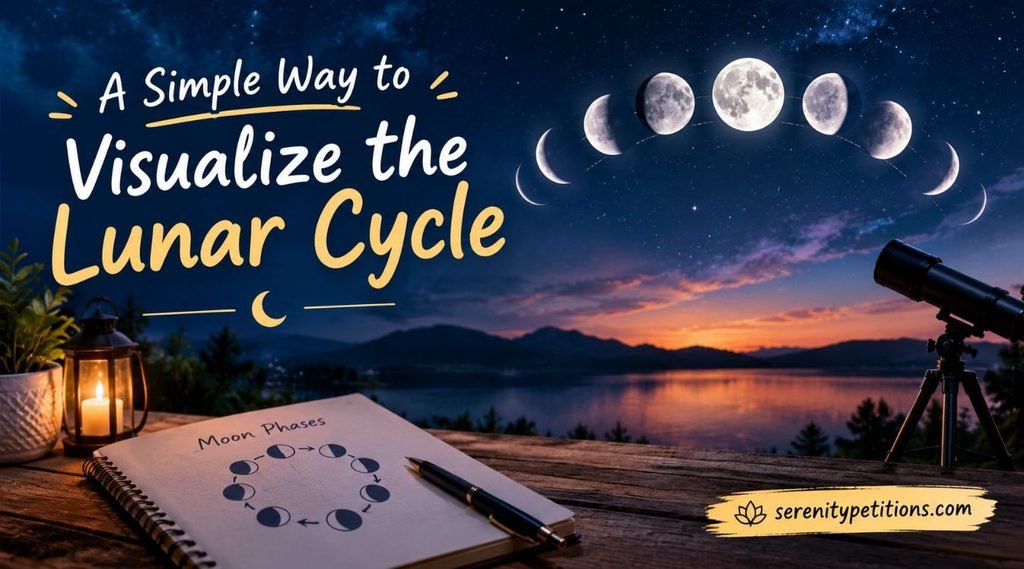
The commonly used sequence is:
🌑 → 🌒 → 🌓 → 🌔 → 🌕 → 🌖 → 🌗 → 🌘 → 🌑
A complete cycle from one New Moon to the next takes about 29.5 days. This period is often called a synodic month.
The actual transition is continuous. The eight phases are convenient reference points rather than eight moments when the Moon suddenly changes appearance.
Imagine a ball sitting in a dark room while a flashlight shines on it.
The flashlight represents the Sun, the ball represents the Moon, and you represent an observer on Earth.
As the ball moves around you, you see different amounts of its illuminated side.
That is basically what happens with the Moon.
The current phase of the moon emoji is always being illuminated by the Sun on one side. What changes is the portion of that illuminated surface visible from Earth.
This simple idea explains why the Moon can look like a thin crescent one night, half illuminated later, and nearly completely bright afterward.
If the terms waxing and waning keep getting mixed up, use Full Moon as your reference point.
Everything moving toward 🌕 is waxing.
Everything moving away from 🌕 is waning.
🌒 → 🌓 → 🌔 → 🌕
The illuminated portion grows.
🌕 → 🌖 → 🌗 → 🌘 → 🌑
The illuminated portion shrinks.
This trick is especially helpful when selecting a current moon emoji from a chart. You do not have to memorize every detail. Just ask whether the Moon is getting brighter or darker.
The current phase of the moon emoji changes because the real Moon continuously moves through its orbit around Earth.
The emoji does not physically change. Your selected emoji changes because the Moon’s astronomical phase changes.
For example, a date near Full Moon might call for 🌔 before the peak, 🌕 at Full Moon, and 🌖 afterward.
That is why searches for moon phase emoji today need a date attached to them. A result that was accurate last week may no longer match the Moon now.
For an accurate answer, check the current date, local time, and a reliable lunar calendar.
Your location usually does not change the fundamental lunar phase itself. However, it can affect when you experience or label that phase locally.
A specific lunar event happens at a particular moment worldwide, but clocks and dates differ between time zones.
Location also affects practical viewing details such as:
For example, the Full Moon on September 26, 2026, reaches its peak at 9:49 PM in Multan local time.
So, when searching for a moon phase emoji by location, use a lunar calendar that supports your city or time zone.
No. current phase of the moon emoji are fixed Unicode characters.
If you type 🌕 tomorrow, it will still display as 🌕 even if tomorrow’s real Moon is a crescent.
Your phone does not connect the emoji to astronomical data when you type it into a message.
That means:
You choose the symbol based on the real Moon phase.
A real Moon and a moon emoji serve very different purposes.
The real Moon changes continuously. A standard emoji gives you a simplified visual representation of one major phase.
The real Moon’s illumination changes gradually rather than jumping between eight categories.
Its appearance can also depend on:
There are countless possible illumination percentages between New Moon and Full Moon.
A current phase of the moon emoji reduces that continuous cycle into a small set of recognizable symbols.
For instance, there is no standard Unicode emoji specifically for “87% illuminated and waning.”
Instead, 🌖 is used to represent the broader Waning Gibbous category.
That makes moon emojis convenient, but they should not be treated as precision astronomy diagrams.
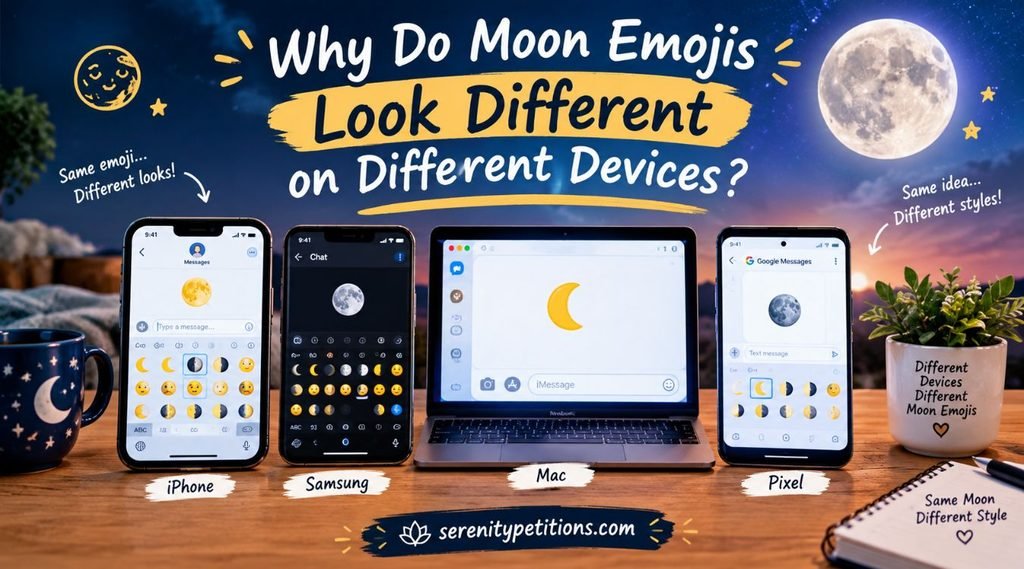
You may notice that 🌕 looks slightly different on an iPhone compared with an Android phone or computer.
That happens because Unicode defines the character and its meaning, while individual platforms create their own artwork.
Apple, Google, Samsung, and other platforms can therefore give the same emoji a different visual style.
Differences may include:
The design may change, but the Unicode meaning stays the same.
So, whether your phone displays 🌖 as a realistic Moon or a simpler illustration, it still represents Waning Gibbous.
Finding the current moon phase emoji is easier when you separate the process into three steps.
First, check a reliable lunar calendar for the current date.
Second, identify the Moon phase.
Third, match that phase with the corresponding emoji.
For example:
Full Moon → 🌕
Waning Gibbous → 🌖
Last Quarter → 🌗
Waning Crescent → 🌘
This method works whether you’re checking the Moon for astronomy, social media, a lunar journal, or a puzzle.
A good moon phase calendar can show much more than the phase name.
Depending on the service, you may find:
This information becomes particularly useful near a phase transition.
A Moon that is 99% illuminated can look almost identical to a Full Moon, even though the exact Full Moon moment may occur later.
For date-sensitive searches, always check the calendar for your actual date and location.
Once you’ve checked the lunar calendar, note the exact phase name.
Do not try to choose the emoji based only on how bright the Moon looks.
For example, if the calendar says Waxing Gibbous, choose 🌔 even if the Moon appears almost full.
Likewise, if it says Waning Gibbous, use 🌖 even when the difference from Full Moon is difficult to notice.
The phase name gives you the correct category.
After identifying the phase, the conversion is straightforward:
That’s all you need for a matching moon phase emoji.
No telescope is necessary. 🌙
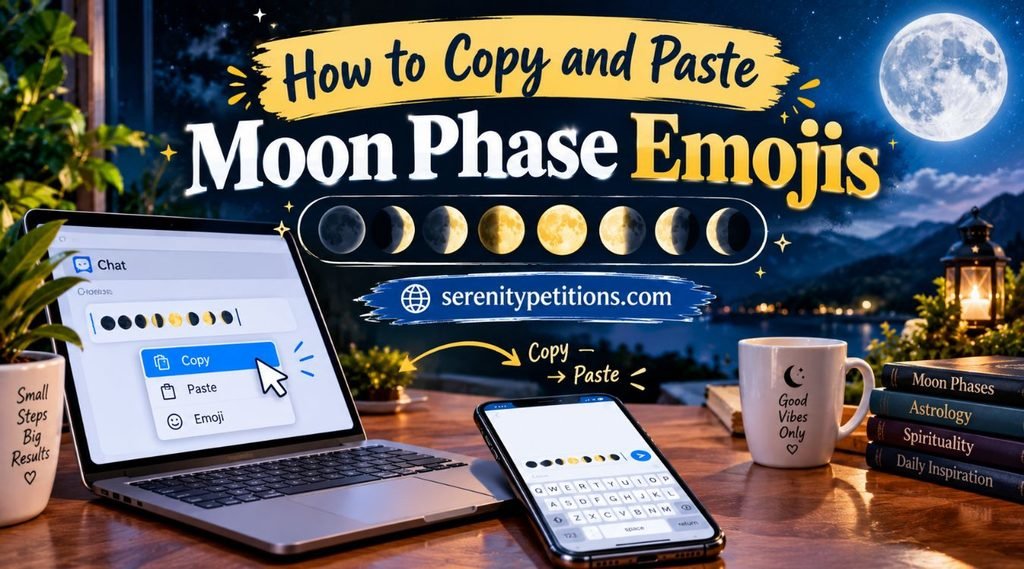
If you simply need the symbols, you can copy them directly from this list:
🌑 🌒 🌓 🌔 🌕 🌖 🌗 🌘
These moon phase emoji copy and paste options work well in most modern apps and websites.
You can use them in:
Just remember that copying 🌕 does not mean the real Moon is currently full.
Here is the full set again for quick access:
🌑 New Moon
🌒 Waxing Crescent
🌓 First Quarter
🌔 Waxing Gibbous
🌕 Full Moon
🌖 Waning Gibbous
🌗 Last Quarter
🌘 Waning Crescent
For everyday use, you can also pair them with other symbols:
🌕✨
🌙⭐
🌒🌌
🌖✨
That can make captions and messages feel more atmospheric without overdoing it.
current phase of the moon emoji have plenty of uses beyond astronomy.
Someone might want the current lunar phase emoji for a social media caption, a text message, an astronomy assignment, or even a date-specific puzzle.
The right symbol depends on what you’re trying to communicate.
Moon emojis are an easy way to add a nighttime or celestial feeling to social media posts.
For example:
If your post is specifically about the real Moon, using the correct moon phase emojis for captions adds a small touch of accuracy.
If you’re using the emoji purely for style, exact astronomical matching matters less.
current phase of the moon emoji also work naturally in everyday conversations.
You might send 🌙 when saying goodnight, 🌕 when talking about a Full Moon, or 🌑 when discussing a New Moon.
Examples include:
In texting, context often matters more than scientific precision.
Moon phase symbols can make lunar tracking much easier.
Instead of writing the complete phase name every day, you can use the corresponding emoji as a quick visual marker.
For example:
🌑 → 🌒 → 🌓 → 🌔 → 🌕 → 🌖 → 🌗 → 🌘
A journal containing this sequence immediately shows how the lunar cycle progresses.
This can be useful for astronomy observations, photography planning, personal notes, or anyone who simply enjoys watching the night sky.
current phase of the moon emoji can also have symbolic meanings in casual communication.
Those meanings are not formal astronomical definitions, but they are common in creative and social contexts.
| Emoji | Astronomical Meaning | Common Symbolic Use |
| 🌑 | New Moon | Beginnings, mystery |
| 🌒 | Waxing Crescent | Growth, possibility |
| 🌓 | First Quarter | Progress, momentum |
| 🌔 | Waxing Gibbous | Anticipation |
| 🌕 | Full Moon | Brightness, completion |
| 🌖 | Waning Gibbous | Reflection, transition |
| 🌗 | Last Quarter | Change, adjustment |
| 🌘 | Waning Crescent | Closure, rest |
For example, someone may use 🌑 to represent starting over even when there is no connection to the actual Moon.
So, always consider the context before interpreting a moon emoji literally.
Choosing the right emoji is simple once you understand the cycle, but several mistakes come up repeatedly.
The most common problems involve confusing waxing with waning, mixing up similar-looking emojis, or assuming an emoji is automatically tied to the current Moon.
The good news? Each mistake has an easy fix.
The simplest way to avoid this mistake is to remember:
Waxing = increasing illumination
Waning = decreasing illumination
If the Moon is heading toward Full Moon, you’re in the waxing part of the cycle.
If it has already passed Full Moon, you’re in the waning part.
This one rule eliminates many mistakes when choosing a waxing moon emoji or waning moon emoji.
🌓 and 🌗 both show approximately half illumination, so they are easy to confuse.
The difference is their place in the lunar cycle.
🌓 is the First Quarter and belongs to the waxing half.
🌗 is the Last Quarter and belongs to the waning half.
Think of 🌓 as moving toward 🌕 and 🌗 as moving away from 🌕.
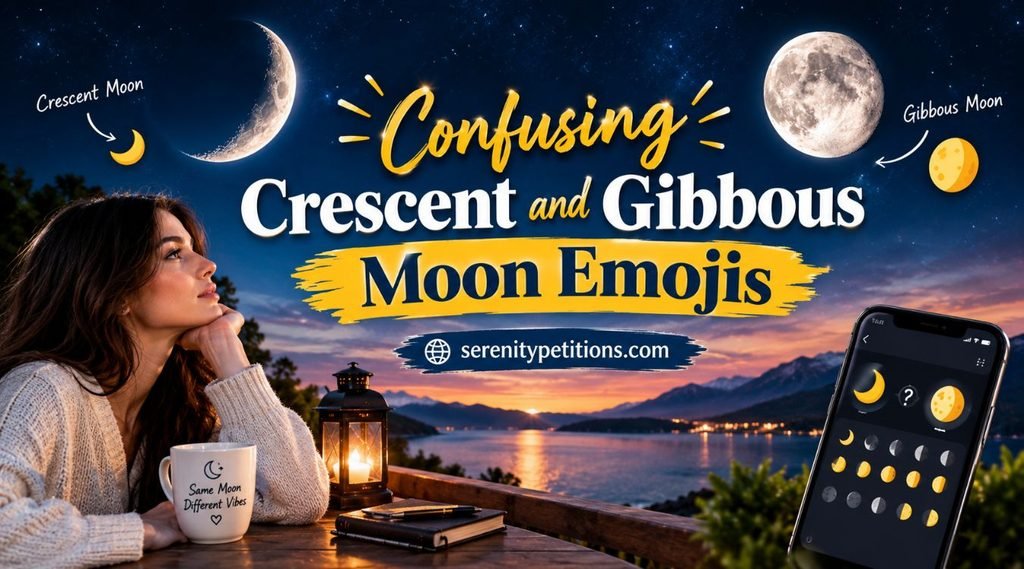
Crescent and gibbous describe the amount of visible illumination.
Crescent: less than half illuminated.
Gibbous: more than half illuminated.
So:
Once you understand those two words, the four emojis become much easier to identify.
Typing 🌕 does not tell anyone what the real Moon is doing.
It simply displays the Full Moon emoji.
If today’s lunar phase is Waning Gibbous, you could still type 🌕 as a decorative symbol, but it would not accurately represent the current astronomical phase.
For astronomy-related posts, use a current moon calendar first.
current phase of the moon emoji information is highly date-sensitive.
An article written for one particular day may give the correct answer for that day but become outdated quickly.
This is especially important for searches such as:
Always verify the date before using a supposedly “current” answer.
Consider September 26, 2026.
The Moon is very close to Full Moon during the day, and the Full Moon event occurs at approximately 9:49 PM in Multan.
That means a person checking early in the day and another person checking later that evening are looking at the Moon at different points relative to the exact Full Moon moment.
The visible difference may be tiny. However, the astronomical timing still matters.
This is a good example of why a moon phase emoji by date should be tied to a specific time and location whenever accuracy is important.
Some online puzzles and games ask for date-specific information. In those situations, the Moon phase may be part of a changing clue or requirement.
The safest process is straightforward:
Do not rely on an answer from yesterday if the puzzle expects today’s information.
The Moon keeps moving, even when your puzzle absolutely refuses to cooperate. 😄
Need the entire cycle at a glance?
Here it is:
🌑 → 🌒 → 🌓 → 🌔 → 🌕
New Moon → Waxing Crescent → First Quarter → Waxing Gibbous → Full Moon
The visible illuminated portion increases throughout this half of the cycle.
🌕 → 🌖 → 🌗 → 🌘 → 🌑
Full Moon → Waning Gibbous → Last Quarter → Waning Crescent → New Moon
The illuminated portion decreases until the next New Moon.
This is one of the easiest ways to remember the lunar cycle emojis.
If you’re looking for the moon phase emoji by date, don’t start with the emoji itself.
Start with the date.
A lunar calendar can tell you which phase occurs on that specific day. Once you know the phase, matching it to a Unicode emoji takes only a few seconds.
This approach works for birthdays, travel dates, astronomy projects, historical events, scheduled social posts, or any other date-specific search.
Enter the date into a reliable lunar calendar and check the listed phase.
For greater accuracy, also look at the local time and location.
For example, the September 2026 lunar calendar for Multan shows the Full Moon event on September 26 at 9:49 PM local time.
That makes the date-specific answer much more useful than simply saying “the Moon is full in September.”
The underlying Unicode emoji is the same, but the artwork can look different across devices.
An iPhone may render 🌕 differently from a Samsung or Google device. The same applies to computers and social media platforms.
The important thing is the character itself, not the exact artwork.
Different platforms may change:
These visual differences do not create different astronomical meanings.
For example, 🌖 remains the Waning Gibbous emoji regardless of whether it looks realistic, flat, glossy, or cartoon-like on your device.
In texting, Moon emojis can have either literal or symbolic meanings.
🌕 may refer to a Full Moon, while 🌙 can simply suggest nighttime or bedtime. 🌑 might represent a New Moon, darkness, or a fresh start.
The surrounding message usually tells you how the sender intends the emoji.
If you’re talking about astronomy, use the emoji that matches the actual lunar phase.
If you’re simply creating a mood, you have more freedom.
For example:
That distinction helps prevent overinterpreting casual emoji use.
The Moon’s phases are simple to observe but surprisingly interesting once you understand what causes them.
Here are a few facts that make the emoji sequence easier to understand.
The Moon appears bright because it reflects sunlight.
Half of the current phase of the moon emoji is always illuminated by the Sun, but Earth-based observers do not always see that entire illuminated half.
Our changing viewpoint creates the different lunar phases.
A complete cycle from New Moon to New Moon takes approximately 29.5 days.
This is why lunar months do not line up perfectly with the standard 30- or 31-day calendar months.
The eight major phases are useful landmarks within that repeating cycle.
The Moon does not suddenly switch from one emoji-like appearance to another.
Its illuminated portion changes continuously.
The eight familiar phases are simply convenient points for describing that ongoing change.
This is also why two lunar calendars can sometimes show slightly different illumination percentages while still identifying the same phase.
The commonly recognized eight phases are:
These phases provide a simple framework for understanding the moon phase cycle.
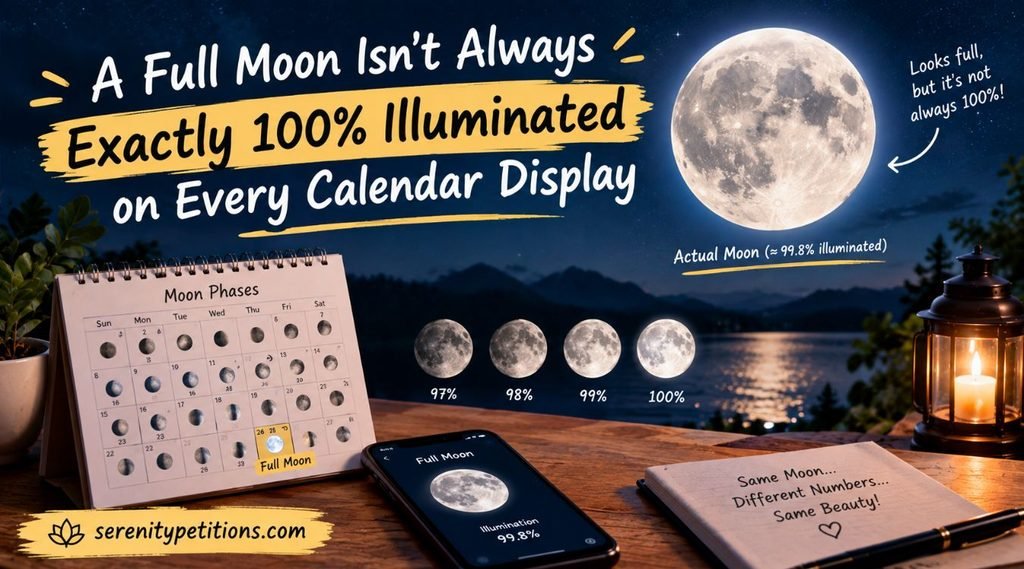
Different lunar calendars may round illumination percentages differently or calculate them at different moments.
A Moon listed as 99.8% illuminated can appear virtually identical to a Full Moon to the naked eye.
That is why the phase name and exact event time can be more useful than obsessing over a tiny percentage difference.
The current phase of the moon emoji is 🌕 Full Moon on September 26, 2026, around the local Full Moon event.
Today’s current phase of the moon emoji is 🌕 because September 26, 2026, reaches the Full Moon phase during the evening.
Check a current lunar calendar, identify today’s lunar phase, then match that phase with the appropriate Unicode moon emoji.
The eight current phase of the moon emoji are 🌑 🌒 🌓 🌔 🌕 🌖 🌗 🌘, covering the major stages of the lunar cycle.
No. current phase of the moon emoji are fixed Unicode symbols, so you must manually choose the matching moon phase emoji.
🌔 represents Waxing Gibbous before Full Moon, while 🌖 represents Waning Gibbous after the Full Moon.
Yes. Use a current phase of the moon emoji calendar for the specific date and location, then select the emoji matching that listed lunar phase.
Finding the current phase of the moon emoji is much easier when you understand the basic lunar cycle.
The real Moon changes continuously as it orbits Earth, while Unicode gives us a small set of symbols representing its major phases. The key is to identify the actual lunar phase first and choose the corresponding emoji second.
The complete sequence is:
🌑 → 🌒 → 🌓 → 🌔 → 🌕 → 🌖 → 🌗 → 🌘
For September 26, 2026, the Moon reaches its Full Moon phase at about 9:49 PM local time in Multan, so 🌕 is the appropriate emoji around that event.
Whether you’re writing an Instagram caption, sending a text, tracking the Moon in a journal, or solving a date-based puzzle, this simple chart gives you a quick way to connect the real Moon with its digital symbol.